


80% of marketers struggle to demonstrate the impact of their campaigns on business outcomes, according to Gartner's Marketing Data and Analytics Survey. At the same time, 58% of marketing leaders report increased pressure from CEOs and boards to prove the value of marketing, according to Deloitte's CMO Survey. And 72% of CMOs say their credibility with finance depends on demonstrating direct revenue impact, according to Forrester's 2025 research.
These three numbers describe the defining challenge of marketing analytics in 2026: the gap between the expectation of measurement and the capability to deliver it. Most marketing teams have more data than at any previous point in history — more channels, more touchpoints, more tools producing more numbers. What most marketing teams lack is not data. It is the analytical framework to convert that data into the specific, credible evidence of business impact that finance, leadership, and boards require.
Understanding how marketing analytics works — which metrics matter, how attribution works, where measurement currently fails, and how to build a measurement approach that produces defensible ROI evidence — is one of the highest-value capabilities for any marketing professional in 2026.
What marketing analytics is — and why it is harder than it looks
Marketing analytics is the practice of measuring, managing, and analysing marketing performance data to maximise effectiveness and ROI. In principle, it answers the questions that matter most to any marketing organisation: which activities are producing results, which are not, how much each customer costs to acquire, and what the overall financial return is on the marketing investment.
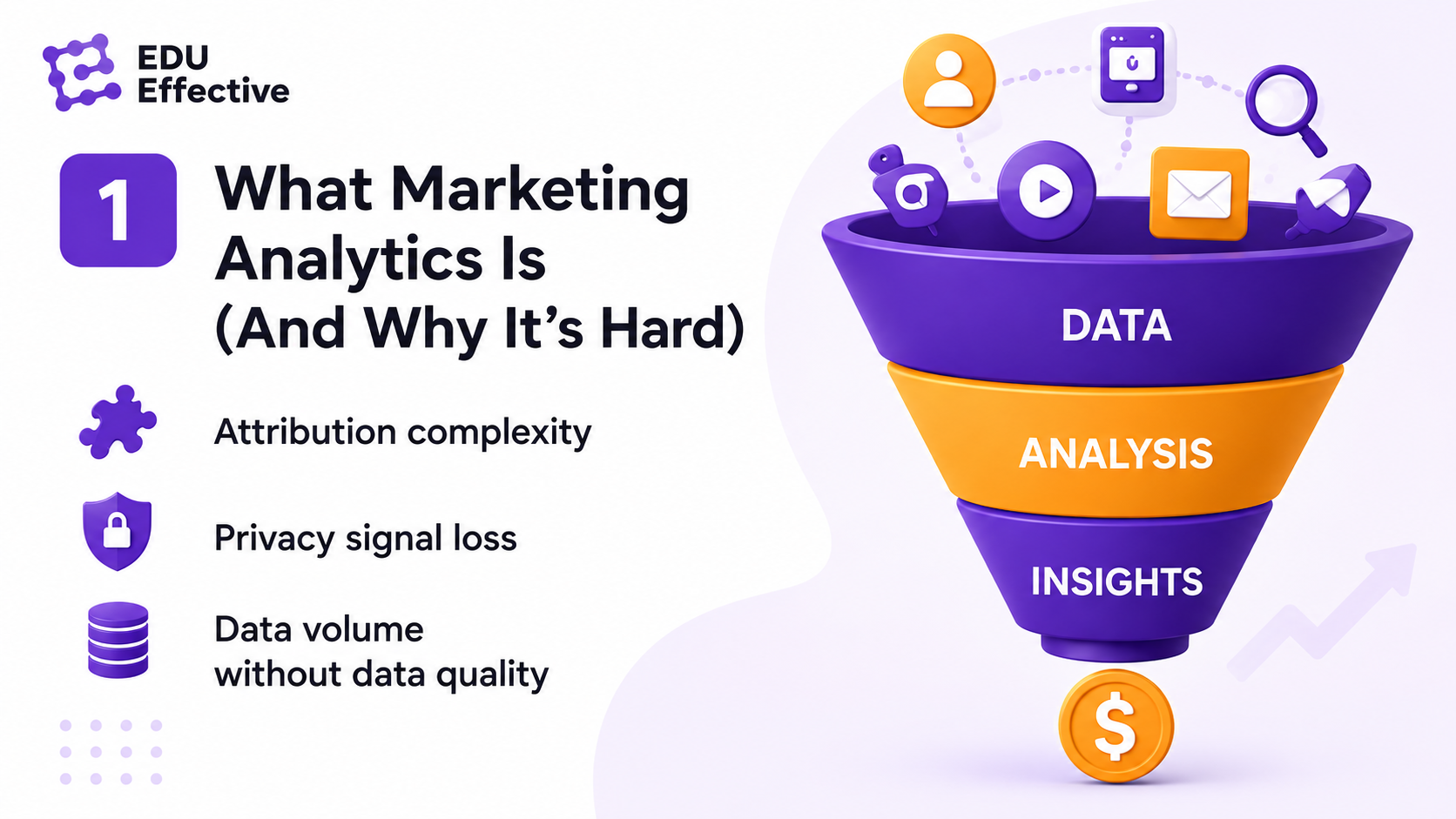
In practice, marketing analytics is significantly more difficult than these questions suggest — for three structural reasons that have intensified in 2026.
Attribution complexity. A potential customer who eventually purchases from a brand may have encountered it through an organic search result, a social media post, an email, a retargeting ad, a referral from a colleague, and a visit to a trade show — in that order, over six months. Which of those touchpoints deserves credit for the purchase? Attribution is the analytical problem of assigning conversion credit to marketing touchpoints, and it does not have a clean solution. Every attribution model makes simplifying assumptions that are wrong in predictable ways. Last-click attribution credits only the final touchpoint and systematically undervalues brand-building and awareness activity. First-click attribution credits only the initial touchpoint and systematically undervalues conversion-stage activity. Multi-touch attribution distributes credit across touchpoints but requires the kind of connected cross-channel tracking that privacy changes have made increasingly difficult.
Privacy signal loss. The erosion of third-party cookie tracking — accelerated by iOS privacy changes, GDPR enforcement, and Google's evolving cookie policy — has removed the cross-site identity signals that most digital attribution models were built on. When a user sees a Facebook ad on their phone, clicks an email on their laptop, and converts through a Google search on their work computer, connecting those touchpoints into a single customer journey requires identity resolution that most tracking infrastructure can no longer provide reliably. Attribution models in 2026 are operating with significant data gaps — and the marketers who do not acknowledge this are reporting numbers that appear precise but reflect incomplete information.
Data volume without data quality. The proliferation of marketing channels, tools, and platforms has produced an enormous volume of data that is often inconsistent, incompletely tagged, siloed across systems, and interpreted differently by different teams. 87% of marketers say data-driven marketing is critical to their strategy, but only 32% trust the quality of their data enough to make decisions based on it with confidence, according to current research. The problem is not collecting enough data — it is ensuring that the data collected accurately reflects marketing activity and can be connected to business outcomes.
The marketing metrics that actually matter — and the ones that do not
The most common failure in marketing measurement is tracking metrics that are easy to measure rather than metrics that indicate genuine business performance. Vanity metrics — numbers that look impressive but do not connect to commercial outcomes — are among the most consistent sources of misaligned investment in marketing.
The test for whether a metric matters is practical: does it connect to a business decision? If a metric cannot answer the question "should we do more or less of this, and why?", it is likely a vanity metric rather than a performance metric.
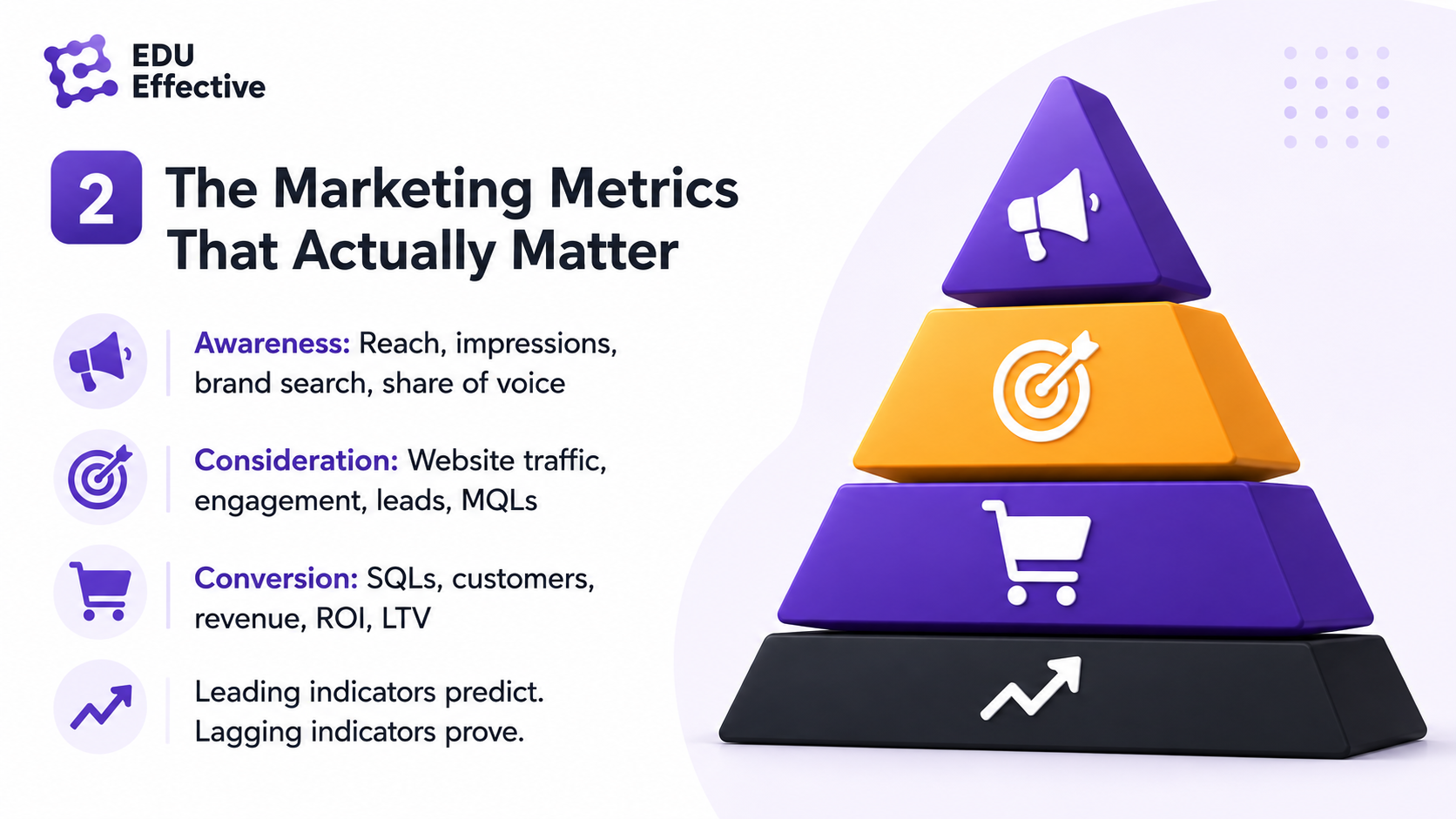
Awareness metrics — reach, impressions, share of voice, brand search volume uplift, and aided/unaided brand recall — measure how successfully marketing is building presence in the target audience's mind. These metrics matter for top-of-funnel activity and brand-building campaigns, but they do not connect directly to short-term revenue. The trap is using awareness metrics to evaluate conversion campaigns, or ignoring awareness metrics in brands where long-term visibility is the primary growth driver.
Engagement metrics — click-through rate, time on site, video completion rate, email open rate, social engagement rate, and content download rate — measure how successfully marketing content is connecting with the audience. Engagement indicates relevance: content that no one engages with is not working, regardless of how much was invested in creating it. But engagement does not equal conversion, and the consistent over-reporting of engagement metrics as evidence of marketing effectiveness is one of the most common measurement mistakes.
Conversion metrics — conversion rate, cost per lead (CPL), cost per acquisition (CPA), return on ad spend (ROAS), and marketing-attributed revenue — measure how successfully marketing investment is producing commercial outcomes. These are the metrics that finance and leadership most directly care about, and they are the most important metrics for evaluating the performance of conversion-stage marketing activity. The limitation of conversion metrics alone is that they capture only the final stages of the customer journey, systematically undervaluing the awareness and consideration activity that made conversion possible.
Retention and lifetime value metrics — customer lifetime value (CLV), churn rate, net revenue retention, and customer satisfaction scores — measure the long-term commercial value of the customers marketing is acquiring. A marketing campaign that acquires many low-value, high-churn customers at low CPA may underperform a campaign that acquires fewer, higher-value, loyal customers at higher CPA when evaluated on CLV rather than acquisition cost alone. The choice of measurement horizon — whether marketing is evaluated on immediate conversion or on long-term customer value — fundamentally changes which activities appear most effective.
The attribution models and when to use each
Attribution is the analytical framework that determines how conversion credit is distributed across the marketing touchpoints that contributed to a sale. Understanding the most common attribution models — and the assumptions each embeds — is essential for interpreting marketing performance data correctly.
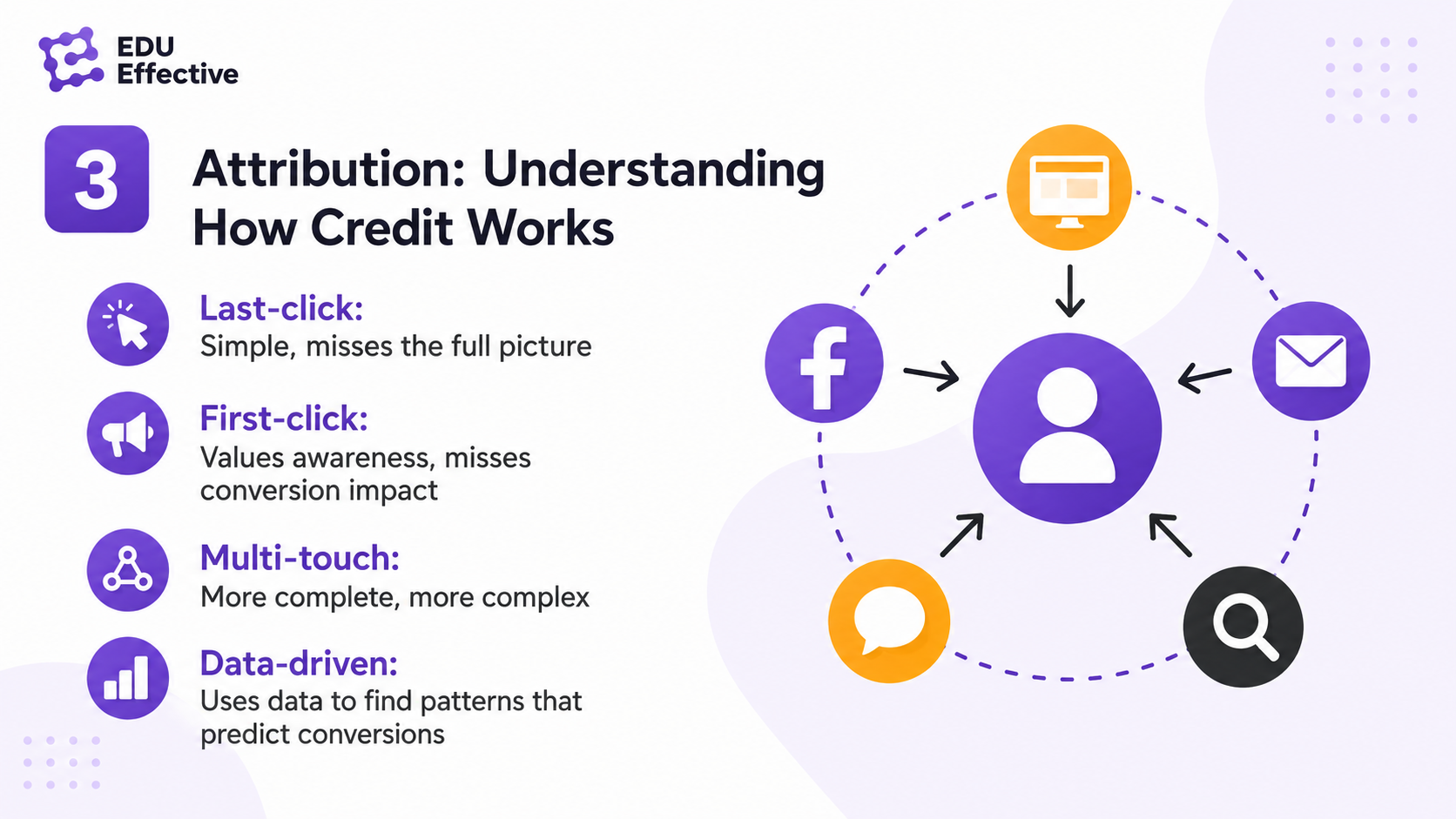
Last-click attribution assigns 100% of the conversion credit to the final touchpoint before purchase. It is the simplest model and the most widely used by default. It is also systematically wrong for most marketing contexts: it overstates the value of bottom-of-funnel tactics (paid search, retargeting) and understates the value of top-of-funnel activity (brand advertising, content marketing, SEO) that built the awareness that made the final click possible.
First-click attribution assigns 100% of the credit to the first touchpoint. It overstates the value of awareness channels and understates the value of conversion-stage activity. It is most appropriate for evaluating campaigns where the primary objective is generating initial awareness and discovery.
Linear attribution distributes credit equally across all tracked touchpoints. It avoids the extreme distortions of single-touch models but introduces its own distortion: treating all touchpoints as equally valuable regardless of their actual influence on the decision.
Time-decay attribution assigns more credit to touchpoints closer in time to the conversion event, reducing credit for earlier touchpoints. It reflects the intuition that recent touchpoints are more proximate causes of a decision, but it systematically undervalues the long-term brand-building that made a prospect receptive to later touchpoints.
Data-driven attribution (DDA) — the model now used by default in Google Analytics 4 — uses machine learning to assign credit based on the actual observed contribution of each touchpoint to conversion probability, rather than applying a fixed rule. It produces more accurate results than rules-based models, but requires substantial conversion data volume to function reliably and is a black box in the sense that the specific credit assignments are not directly auditable.
Marketing mix modelling (MMM) is a statistical technique that evaluates the contribution of different marketing channels to sales outcomes at an aggregate level, without requiring individual-level tracking. It is increasingly preferred in 2026 for budget allocation decisions — particularly in contexts where privacy constraints limit individual-level attribution — because it works with aggregate data and does not depend on cookies or pixel tracking. The limitation is that it produces insights at the level of channel strategy rather than individual campaign optimisation.
The most sophisticated marketing analytics programmes in 2026 run two models in parallel: multi-touch attribution for tactical day-to-day campaign optimisation, and MMM for strategic budget allocation decisions. The combination provides both the granular insight needed for real-time optimisation and the aggregate robustness needed for defensible budget conversations.
The essential marketing analytics toolkit
The tools that marketers use to collect, connect, and analyse performance data have expanded significantly in 2026, creating both more capability and more complexity in building a coherent measurement infrastructure.
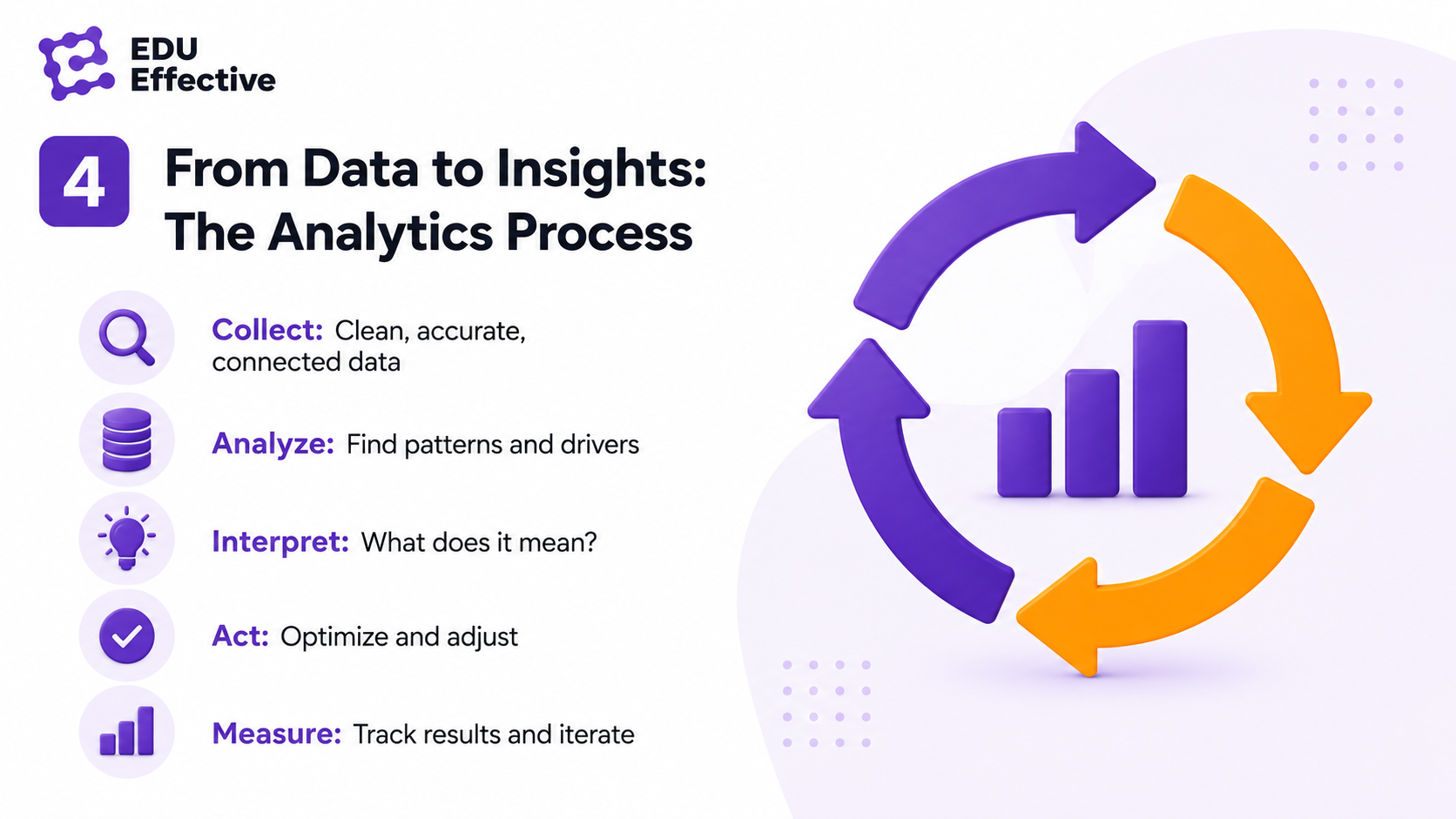
Web analytics — Google Analytics 4 remains the most widely used web analytics platform, providing data on traffic sources, user behaviour on-site, conversion events, and audience characteristics. GA4's data-driven attribution model and its cross-platform measurement capabilities make it the foundational layer of digital analytics for most businesses. Adobe Analytics is the primary enterprise alternative for organisations requiring more advanced segmentation and integration capabilities.
CRM and revenue attribution — connecting marketing activity to actual revenue outcomes requires integrating analytics data with customer relationship management (CRM) systems. HubSpot, Salesforce, and their equivalents serve as the record of what happened in the sales process after marketing generated a lead — and without that connection, marketing analytics can track leads but not their ultimate commercial value.
Campaign and channel analytics — each major paid media platform (Google Ads, Meta Ads, LinkedIn Campaign Manager) provides its own analytics for campaign performance within that platform. The limitation is that each platform's attribution is naturally biased toward its own contribution: Meta's attribution will credit Meta touchpoints, while Google's will credit Google touchpoints, and the two will often add up to more than 100% of actual conversions due to double-counting.
Marketing intelligence and BI tools — Looker, Tableau, Power BI, and similar business intelligence tools aggregate data from multiple sources into unified dashboards that allow cross-channel performance comparison. These tools are essential for senior marketing teams that need to see the full picture across channels rather than channel-specific reporting.
UTM parameters — the simple but essential practice of tagging marketing links with UTM parameters (source, medium, campaign, content, term) allows web analytics systems to correctly attribute traffic from specific campaigns, channels, and content pieces. Without consistent UTM tagging, organic, paid, email, and social traffic can appear as direct traffic in analytics, making channel-level performance invisible.
Marketing ROI: how to calculate it and what it actually measures
The fundamental marketing ROI formula is straightforward:
Marketing ROI = (Revenue attributed to marketing – Cost of marketing) / Cost of marketing × 100
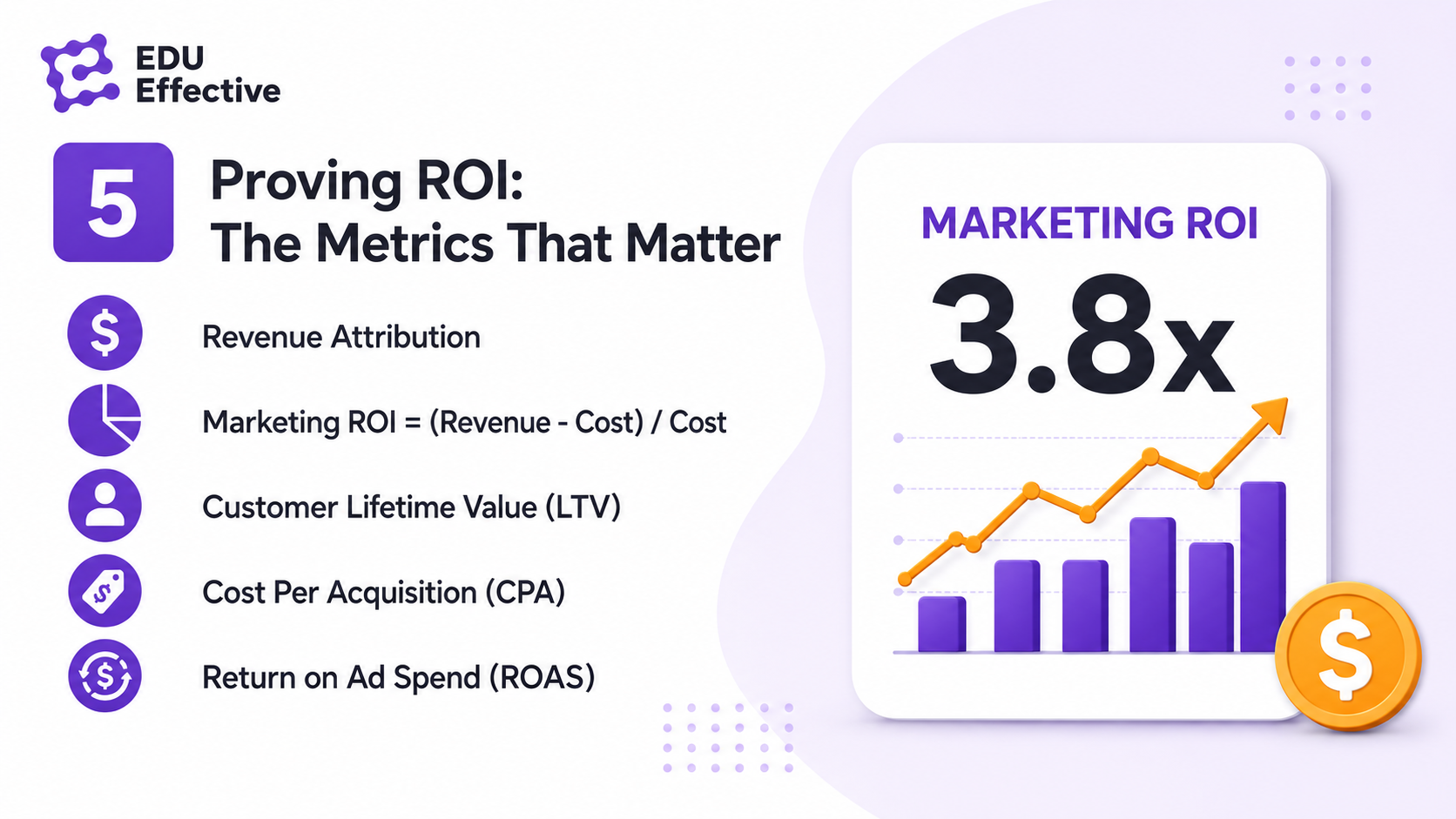
In practice, the complexity lies entirely in the numerator: what counts as revenue "attributed to marketing" and how that attribution is determined. Different attribution models produce different revenue attribution figures for the same campaigns — which is why marketing ROI claims need to specify the attribution model used to be meaningful.
The more useful framing for most marketing teams is not a single ROI number but a channel-by-channel comparison of cost per acquisition, cost per lead, and customer lifetime value that identifies where marketing investment is generating the most efficient returns and where it is generating the least.
McKinsey's analytics research consistently shows that organisations operating at higher levels of analytics maturity achieve substantially higher marketing ROI than those at lower levels: structured investment in measurement infrastructure, attribution capability, and data quality directly produces commercial returns through more efficient marketing investment decisions.
First-party data and the future of marketing measurement
The most significant structural shift in marketing analytics in 2026 is the accelerating transition from third-party data — tracking signals provided by external platforms without requiring a direct relationship with the customer — to first-party data — information provided directly by customers through their own interactions with a brand.

First-party data (email addresses, purchase history, behavioural data on owned properties, survey responses, preference data collected through opt-in mechanisms) is more accurate, more durable, and legally cleaner than third-party data — because it reflects actual customer behaviour observed directly, rather than inferred from external tracking signals that may be incomplete or incorrect.
The transition to first-party data as the primary measurement foundation requires investment in CRM quality, email marketing infrastructure, loyalty programmes, and any mechanism that creates direct, consented relationships with customers. It also requires accepting that some portion of the marketing journey will remain unmeasurable — the "dark funnel" of brand exposure through channels where individual tracking is not possible — and building measurement frameworks that account for this reality rather than ignoring it.
The brands that will measure marketing ROI most accurately in 2026 and beyond are those that have invested in strong direct customer relationships, robust first-party data infrastructure, and the combination of multi-touch attribution and marketing mix modelling that provides defensible performance evidence even when individual-level tracking is incomplete.

At EDU Effective, the Effective MBA: Online Marketing covers marketing analytics, attribution, data strategy, and ROI measurement alongside the full digital marketing curriculum — building the practical skills to measure what matters and make decisions that improve results. Explore the programme →
Related articles
Marketing Funnel: How the Customer Journey Works
Content Marketing Strategy in 2026: What Works, What Has Changed
SEO for Beginners: How Organic Search Works
EDU Effective Business School — professional development for your long-term success.
All five Effective MBA programs are built on the same educational model — designed for working adults who need learning that fits real professional life:
Effective MBA: Executive Management & Leadership
Effective MBA: Applied Artificial Intelligence
Effective MBA: Coaching, Leadership & Mentoring
Effective MBA: Online Marketing
Every programme runs on 15 minutes a day, completes in 10 months or less, is ASIC accredited, and starts from €990.
These are professional programmes, not academic ones — built for working adults to apply what they learn directly in their own business, not to collect a scholarly credential.
Join more than 9,000 students in over 120 countries who are investing in their professional development and career success. Read the experiences of our graduates here.
Apply now — from €990 · Talk to a Study Advisor
Study with NO risk: 14-day money-back guarantee, no questions asked.
Sources
Gartner — Marketing Data and Analytics Survey: 80% of Marketers Struggle to Demonstrate Campaign Impact on Business Outcomes; CMO Priorities Survey (174 senior marketing leaders, September 2025)
https://www.gartner.com/en/newsroom/press-releases/2025-12-04-cmos-top-challenges-and-priorities-for-2026
Deloitte — CMO Survey: 58% of Marketing Leaders Report Increased Board Pressure to Prove Marketing Value
https://www2.deloitte.com/us/en/pages/chief-marketing-officer/articles/cmo-survey.html
Forrester — 2025 Research: 72% of CMOs Say Credibility with Finance Depends on Demonstrating Direct Revenue Impact
https://www.forrester.com/research/
McKinsey & Company — Marketing Analytics Maturity Research: Organizations at Analytics Maturity Level 3–4 Achieve 2.6x Higher Marketing ROI
https://www.mckinsey.com/capabilities/growth-marketing-and-sales/our-insights
HubSpot — State of Marketing Report 2026: 78% of Marketers Use AI Tools in Daily Workflow
https://www.hubspot.com/state-of-marketing
Salesforce — State of Marketing 2026: Data-Driven Marketing Adoption and Performance Data
https://www.salesforce.com/resources/research-reports/state-of-marketing/