


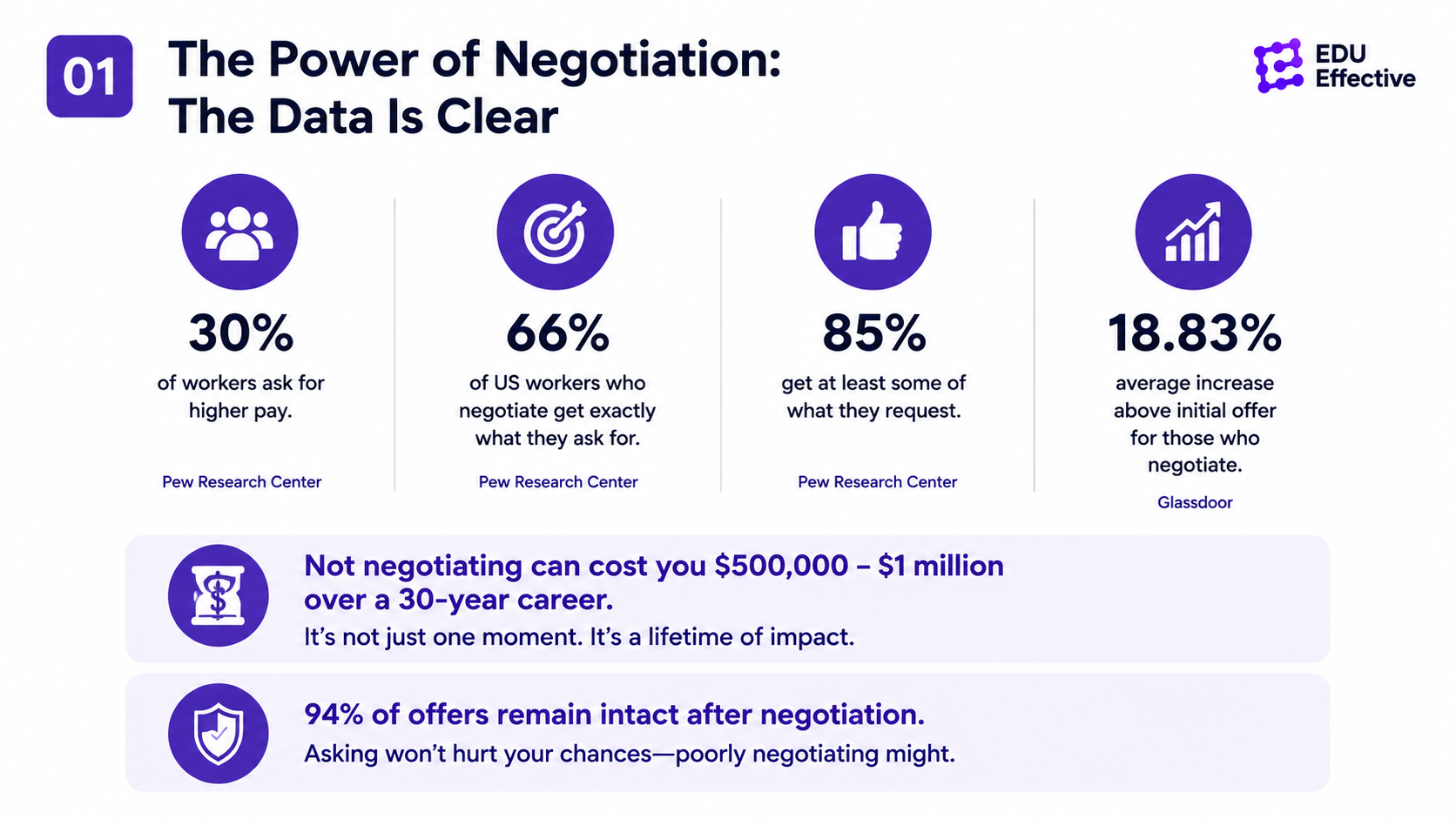
Only 30% of workers ask for higher pay when hired or during employment. Yet the Pew Research Center found that the majority of those who do ask, walk away with more money — and Pew Research Center data shows that 66% of US workers who attempted to negotiate their starting salary got what they asked for, and 85% received at least some of what they requested. Glassdoor's analysis of salary negotiation outcomes found that those who negotiated received an average increase of 18.83% above the initial offer — which on a $130,000 base salary compounds to more than $150,000 in additional earnings over five years.
The arithmetic is not subtle. If you are not negotiating your salary, you are not simply leaving a one-time sum on the table. You are accepting a lower base from which every future raise, bonus, and pension contribution is calculated. Over a thirty-year career, not negotiating a single early-career salary is estimated to cost the average professional between $500,000 and $1 million in lifetime earnings.
The barrier is almost never information. It is fear. A LinkedIn survey found that 62% of professionals say they fear salary negotiation because of concerns about damaging the relationship with their employer. That fear is largely unsupported by evidence: research consistently shows that 85% of people who negotiate get at least some of what they ask for, 66% get exactly what they request, and 94% of offers remain intact after negotiation. The consequence that people fear most — losing an offer or damaging a relationship by asking — happens in a small fraction of cases and almost always involves how a negotiation is conducted, not whether it happens.
Why 2026 is a particularly good time to negotiate
Three structural changes in the 2026 labour market have shifted the balance of power in compensation negotiations toward professionals with demonstrable skills.
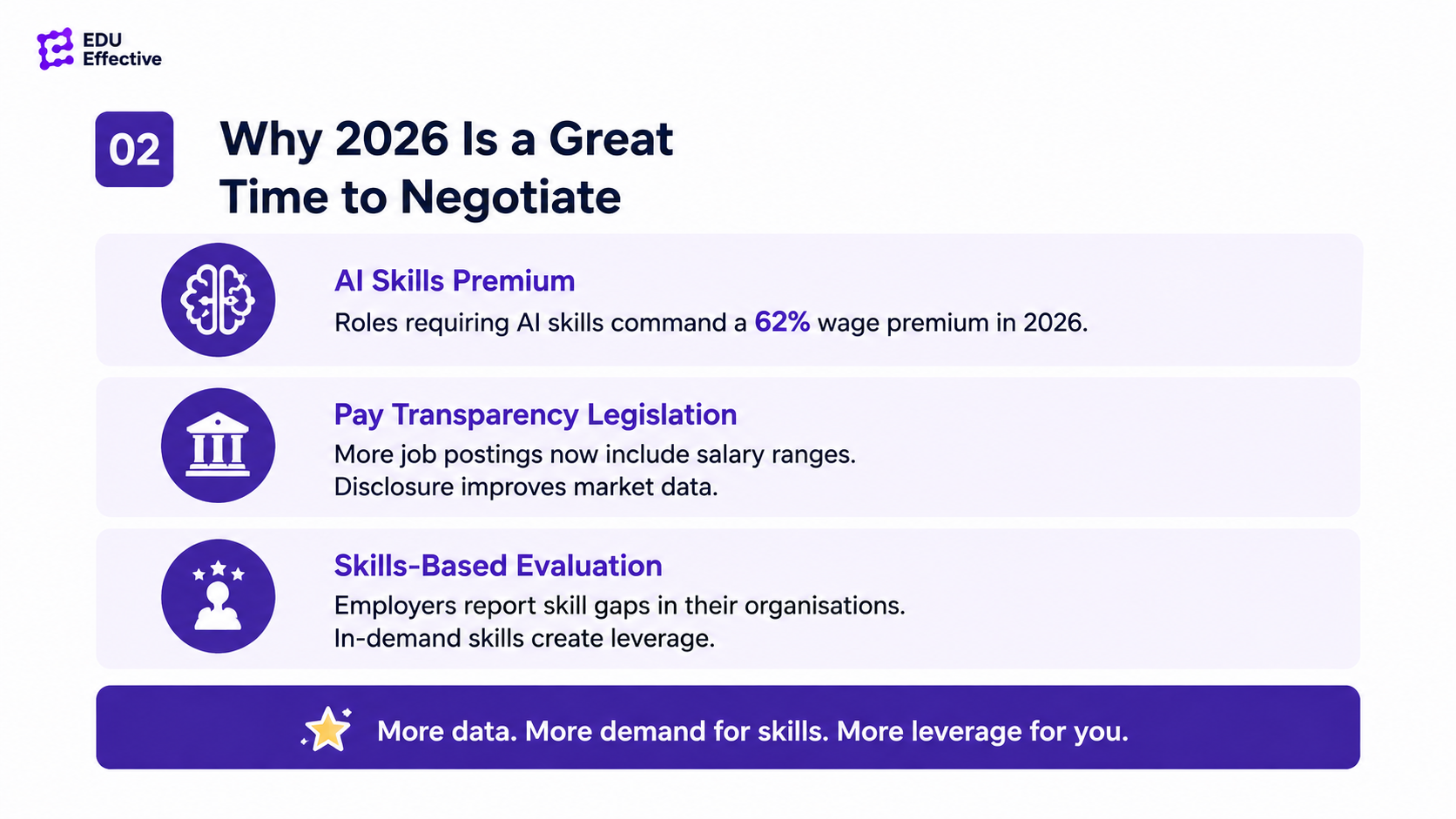
AI skills premium. PwC's 2026 Global AI Jobs Barometer, which analysed more than one billion job advertisements across 27 countries, found that roles requiring AI skills now command a 62% wage premium over comparable roles without them. That premium has climbed from 25% in 2024 to 57% in 2025 to 62% in 2026 — it is not stabilising, it is accelerating. The premium extends well beyond technical roles: it applies across marketing, finance, HR, operations, and general management. Professionals who have built genuine AI fluency and can demonstrate it specifically have a stronger negotiating position than at any previous point. Here is what building genuine AI fluency actually requires in practice — and why the 62% wage premium it commands in 2026 represents the single largest leverage point available in a compensation negotiation.
Pay transparency legislation. More than 68% of job postings in the US included salary ranges in 2025, up from 45% in 2023. Sixteen states plus Washington D.C. now require employers to disclose salary ranges in job postings, covering more than half the US workforce. Colorado's pay transparency law, studied by researchers from UC San Diego, USC, and Lightcast, produced a 3.6% increase in posted salaries after going into effect. For professionals negotiating compensation, this legislation provides data that was previously unavailable — allowing anyone to see what comparable roles actually pay in the current market, in the markets where this information must be disclosed.
Skills-based evaluation. McKinsey research found that 87% of executives say their organisations face current or anticipated skill gaps. In this environment, professionals who demonstrably fill critical skill gaps — in leadership, AI, management, or specialist technical domains — have leverage that professionals with undifferentiated experience do not. Understanding where your skills sit relative to what your employer needs is the foundation of a credible negotiation. This is also how salary negotiation fits into the broader strategy for advancing your career in 2026 — and why the same skill premium data that informs the negotiation should also drive your development priorities.
The foundation of every successful salary negotiation: market data
The most common and most costly mistake in salary negotiation is entering without specific, current market data. Gut feeling, what a colleague mentioned, or what you earned at a previous job are weak arguments. Current, role-specific, location-adjusted market data is a strong one.
For any salary negotiation in 2026, the preparation sequence is the same regardless of whether you are negotiating a new offer or asking for a raise in your current role.
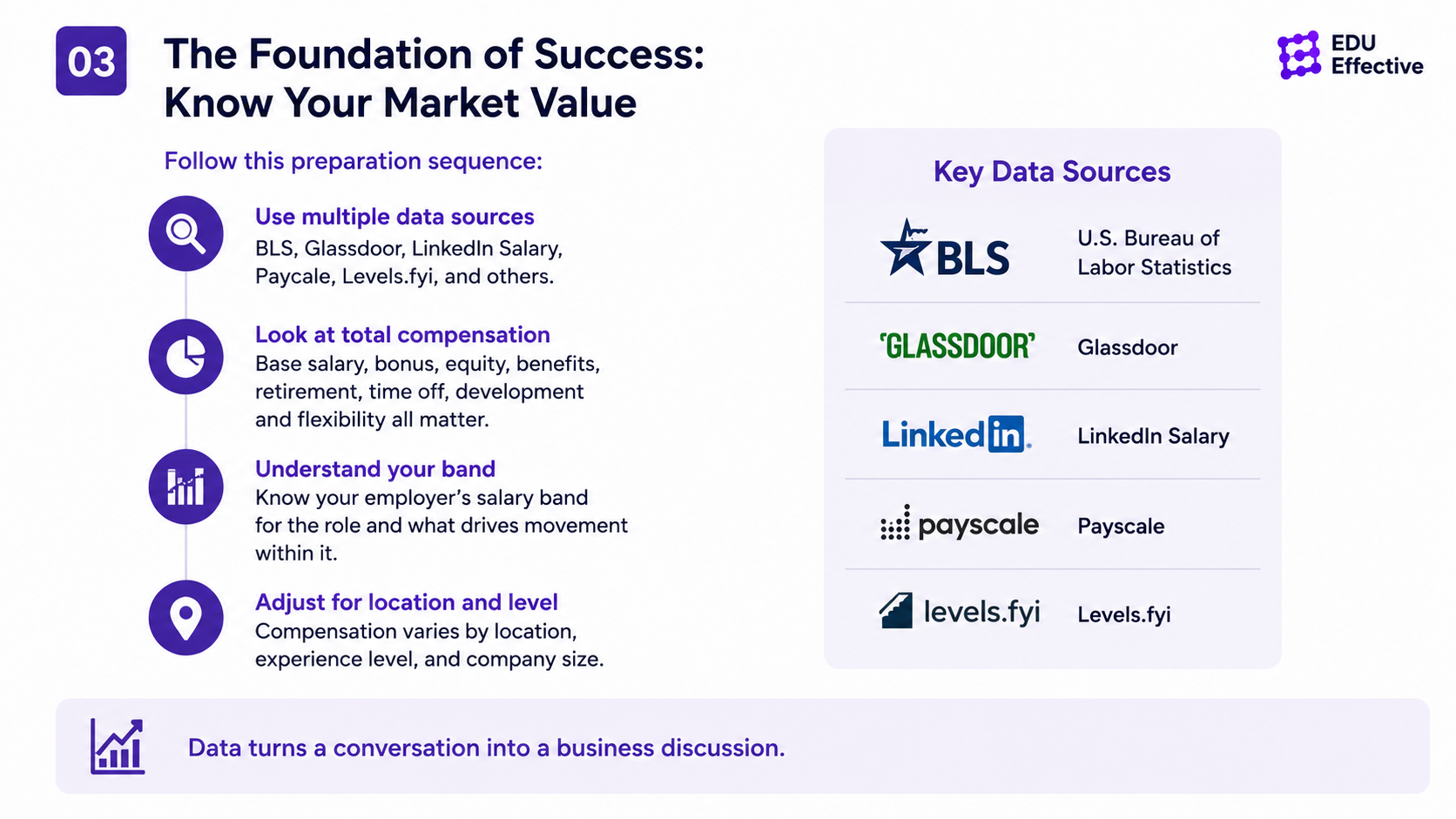
Start with multiple data sources rather than one. The US Bureau of Labor Statistics Occupational Employment and Wage Statistics tool provides median wages by role, industry, and location — the most credible single source, though not always the most current. Cross-reference with Glassdoor, LinkedIn Salary, and Payscale — each draws from different data populations, and the range across all three gives you a triangulated market picture more reliable than any single platform. For technology and finance roles, Levels.fyi provides particularly granular compensation data.
Pay attention to the full compensation picture. Base salary is one component of total compensation. Equity, bonus structures, pension contributions, health insurance quality, professional development budget, flexible working arrangements, and additional leave all have financial value. In senior roles especially, total compensation can differ substantially from base salary — and negotiating on total compensation rather than base alone often produces better outcomes, because some elements (particularly equity and bonus) are more flexible than base salary in many organisations.
Distinguish between what the market pays and what your employer's internal band allows. Employers typically have salary bands for each role — a defined range within which they can offer compensation. Understanding whether you are at the bottom, middle, or top of the relevant band, and what drives movement within it, is as important as knowing the external market. If the external market rate for your role significantly exceeds your employer's band, that is different information than if you are simply at the lower end of a competitive band.
Knowing your value: the evidence that makes a negotiation credible
Market data establishes what the role is worth. Your personal evidence establishes what you are worth within that market — and the gap between these two things is where the strongest salary arguments are built.
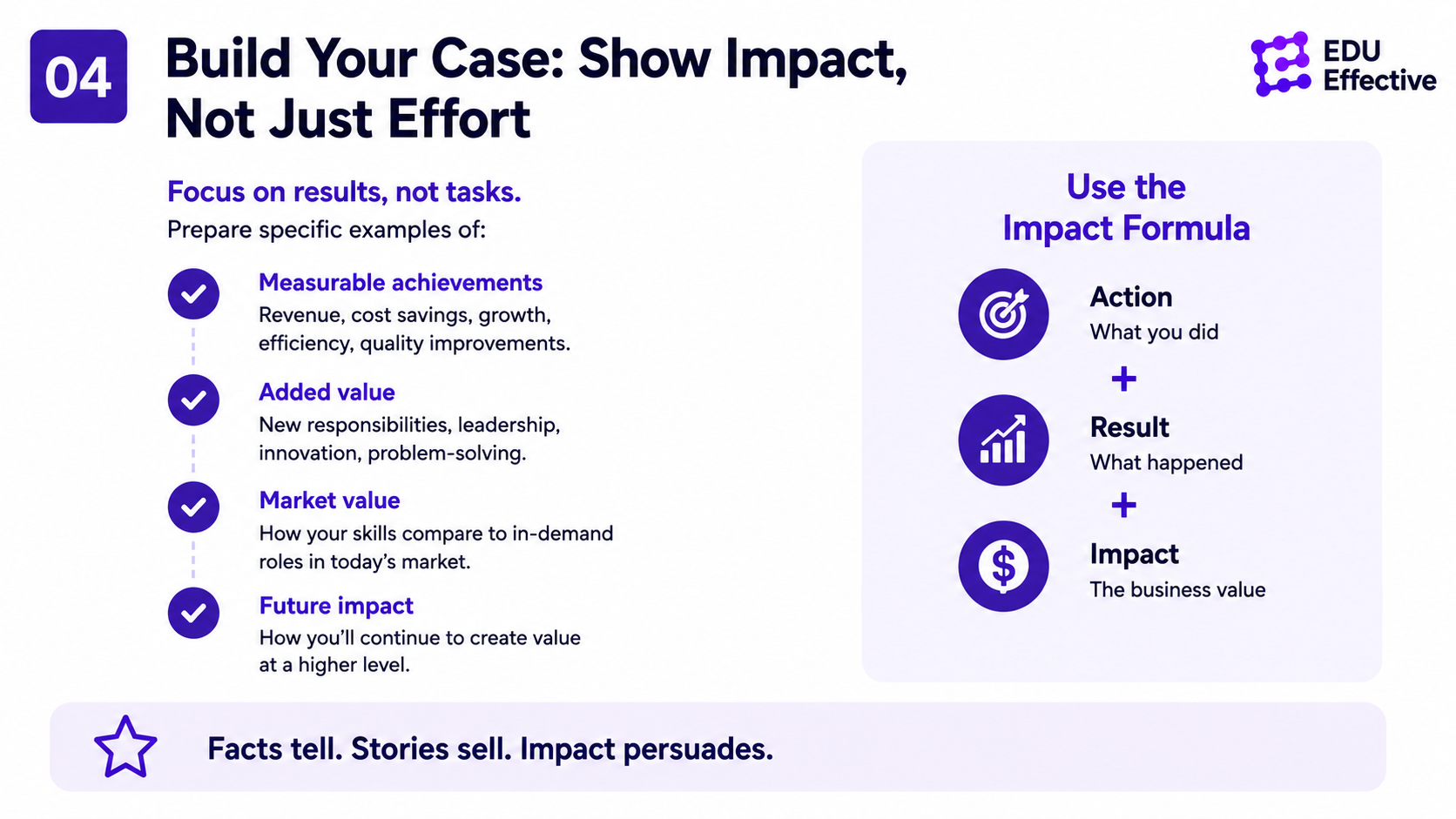
The evidence that carries most weight in a salary negotiation is specific, quantified, and recent. Revenue generated or protected, cost savings delivered, projects completed ahead of schedule or under budget, team performance improvements, customer satisfaction increases — any outcome you can express as a number is more persuasive than any outcome expressed as an adjective.
Before any salary conversation, document your contributions from the past twelve months specifically. What has changed because of your work? What problems have you solved that your role description did not require you to solve? What capabilities do you now bring that you did not bring when your current salary was set? This evidence does two things: it gives you specific material to reference in the negotiation, and it reframes the conversation from "I want more money" to "here is the value I have delivered and here is what comparable value is worth in the current market."
Professional development credentials strengthen the evidence base. A professional completing an accredited qualification in leadership, AI, or marketing during a period of employment can point to that credential as concrete evidence of expanded capability — particularly if the skills developed are directly applicable to current employer priorities. In a market where AI skills command a 62% wage premium and leadership capability is the single most frequently cited skill gap in organisations, documented development in these areas is not merely impressive. It is commercially relevant. This is how structured professional development creates the documented capability evidence that makes a salary negotiation credible beyond market data alone — and why an accredited qualification in the skills your employer needs most is among the strongest arguments available.
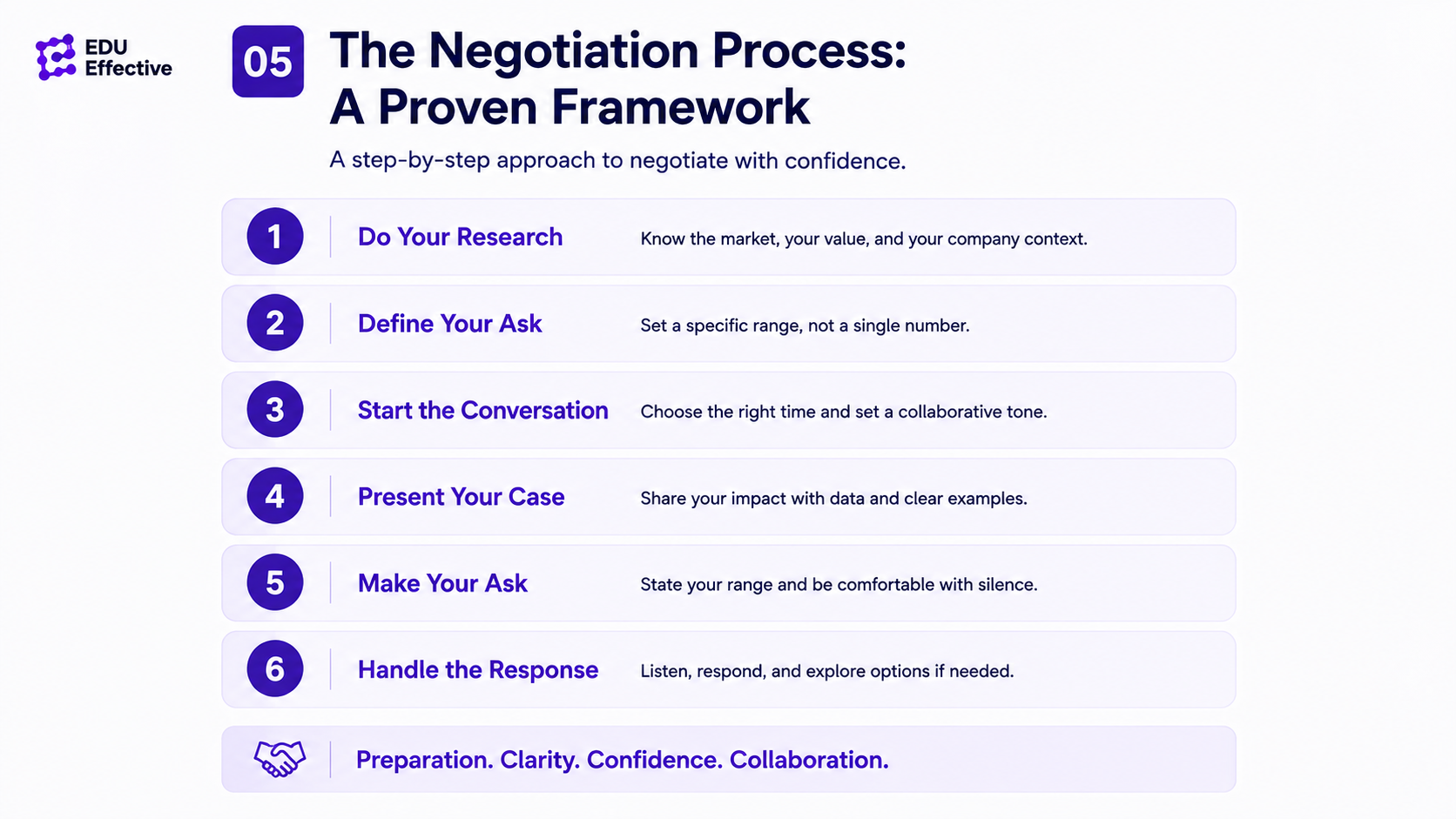
How to have the conversation: practical structure
Timing matters. The strongest moments for a raise conversation are immediately after a significant, visible achievement — when your value is most salient to your manager; during the budget cycle, when decisions about compensation are actually being made; and at formal review periods. Avoid raising it when your manager is distracted by a crisis or a deadline, when the company has just announced disappointing results, or when you have recently made a visible mistake.
Open with appreciation, not demand. A salary negotiation that opens with "I deserve more money" or "other companies pay more" immediately creates defensiveness. An opening that references your commitment to the role and your interest in a long-term future with the organisation sets a collaborative rather than adversarial tone — which is where the best negotiation outcomes occur.
State a specific number, not a range. Research consistently shows that anchoring with a specific number — "I'm looking for £72,000" — produces better outcomes than stating a range — "I'm looking for £68,000 to £75,000." When you give a range, the other party hears the lower number as your floor and negotiates from there. A specific anchor sets the reference point for the entire conversation.
Back the number with your evidence. "I'm asking for £72,000 because the market data for this role at my level in this location sits between £68,000 and £76,000, and given what I've delivered in the past twelve months — specifically X, Y, and Z — I believe I'm performing at the upper end of that range."
Listen more than you talk after making your case. Silence after stating your ask is uncomfortable but productive. Resist the urge to fill it with qualifications or lower offers. Let the other person respond.
Preparation improves delivery, and an outside perspective improves preparation. This is how a mentoring relationship helps you prepare for a salary negotiation — specifically by giving you an honest outside perspective on how your contributions are perceived before you make the case yourself.
When the answer is no — and what to do with it
A refusal is not the end of a negotiation. It is information.
Understanding why the answer is no determines what options are available. If the constraint is budget cycle timing, ask when the right moment would be and get a specific commitment. If the constraint is the salary band, ask what movement within or beyond the band would require — and what the path to that looks like. If the answer is performance-based, ask specifically what performance evidence would make a pay increase appropriate, and agree on a timeline to review.
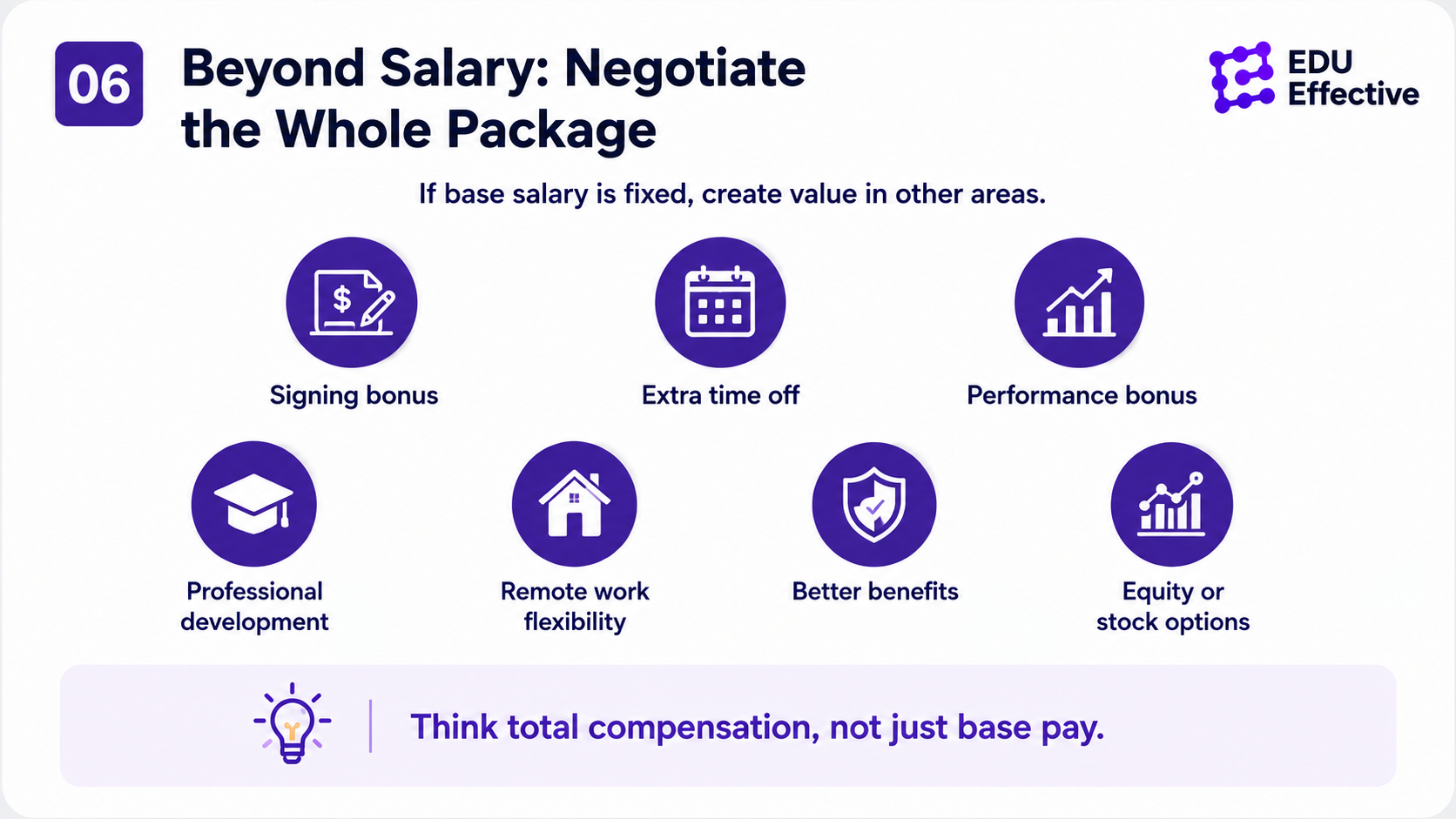
Ask for something else if the base is genuinely fixed. Additional equity, an enhanced bonus structure, an accelerated performance review date, a professional development budget, extra leave, or a flexible working arrangement all have real financial or quality-of-life value. A no on base does not preclude a yes on total compensation.
Document the conversation and follow up in writing. "Thank you for our conversation today. To summarise what we discussed: my current performance, the timeline for review, and the criteria that would support a salary increase..." A written summary protects both parties and demonstrates professional seriousness.
The total compensation frame: beyond base salary
In 2026, compensation negotiation that focuses exclusively on base salary misses a significant portion of what can be negotiated. Total compensation includes:
- Equity and profit sharing — in technology, scale-up, and many professional services environments, equity can represent a substantial multiple of base salary. Understanding vesting schedules, strike prices, and dilution protection matters.
- Bonus structure — the difference between a discretionary bonus and a performance-based bonus with defined criteria is significant. The former is entirely at employer discretion; the latter creates a clearer path to predictable additional income.
- Professional development budget — a company-funded professional development programme worth €2,000–€5,000 per year has direct financial value and supports the ongoing skills development that drives future salary growth.
- Flexible working — in markets where remote or hybrid work is valued, a fully flexible arrangement may be worth the equivalent of a significant salary premium when travel costs, time, and quality-of-life factors are accounted for.
- Pension contributions above the statutory minimum — often overlooked in negotiations but significant over a career.
The most effective salary negotiators in 2026 approach compensation as a system of interconnected elements rather than a single number — which creates more opportunities to reach an outcome that satisfies both parties.
Among the elements that carry the most weight in a 2026 negotiation, leadership capability stands out. This is why leadership capability development is the highest-returning human skill investment in the 2026 labour market — and how to translate that development into a specific negotiation argument.
At EDU Effective, our MBA programmes develop the leadership, management, and AI capabilities that build the demonstrable market value behind a strong salary negotiation — not just the confidence to ask, but the evidence to justify the ask. Explore our programs →
EDU Effective Business School = professional development for your long-term success.
All best-selling Effective MBA programs are built for working adults: 15 minutes a day, 10 months or less, ASIC accredited, from €990.
- Effective MBA: Executive Management & Leadership
- Effective MBA: Applied Artificial Intelligence
- Effective MBA: Coaching, Leadership & Mentoring
- Effective MBA: Mastery in AI
- Effective MBA: Online Marketing
These are professional programmes, not academic ones — built for working adults to apply what they learn directly in their own business, not to collect a scholarly credential.
Join more than 9,000 students in over 120 countries who are investing in their professional development and career success.
Read the feedback and experiences of our students and the stories of our graduates here.
Apply now — €990 · Talk to a Study Advisor
Study with NO risk: 14-day money-back guarantee, no questions asked.
Sources
- PwC — 2026 Global AI Jobs Barometer (1B+ job ads, 27 countries) https://www.pwc.com/gx/en/news-room/press-releases/2026/pwc-2026-ai-jobs-barometer.html
- Glassdoor — Salary Negotiation Outcomes: Average Increase Data https://www.glassdoor.com/research/
- Lightcast — Impact of Colorado Pay Transparency Law on Posted Salaries https://lightcast.io/resources/
- LinkedIn — 2025 Workplace Learning Report: Salary Negotiation and Career Development https://learning.linkedin.com/resources/workplace-learning-report
- McKinsey & Company — Beyond Hiring: How Companies Are Reskilling to Address Talent Gaps https://www.mckinsey.com/capabilities/people-and-organizational-performance/our-insights/beyond-hiring-how-companies-are-reskilling-to-address-talent-gaps
- Harvard Business Review — Salary Negotiation Research and Strategies https://hbr.org/topic/subject/compensation
- US Bureau of Labor Statistics — Occupational Employment and Wage Statistics https://www.bls.gov/oes/