

66% of workers have changed or seriously considered changing career fields in the past year, according to FlexJobs' 2026 State of the Workplace Report. 43% are actively trying to make a switch right now. Career change is not a niche life event — it is one of the most common professional decisions working adults make, and it is becoming more common as AI restructures job markets and skill requirements evolve faster than at any previous point in modern employment history.
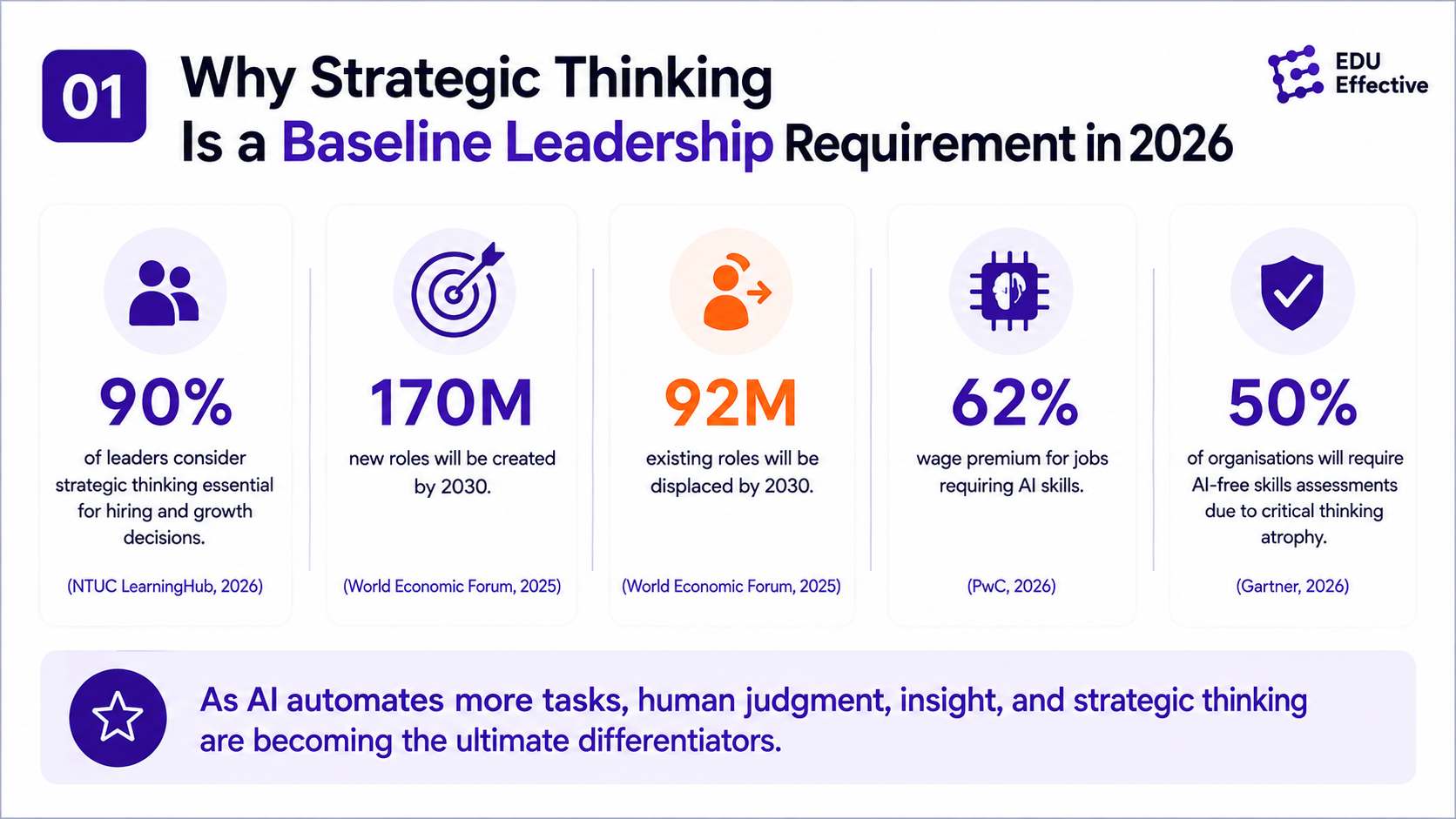
The World Economic Forum projects 170 million new roles will be created by 2030 while 92 million existing ones are displaced — a net gain of 78 million jobs, but a distribution that falls on different people in different places. The workers most at risk are those with skills concentrated in roles AI is automating. The workers best positioned are those who have built transferable human capabilities — judgement, leadership, communication, creativity — and who are actively developing the AI fluency that PwC's 2026 Global AI Jobs Barometer found commands a 62% wage premium across industries. how reskilling — building capabilities for a fundamentally different role — is the skills development strategy that directly underpins a successful career change, and what the WEF's projection of 19 workers in every 100 needing to reskill by 2030 means in practice for anyone considering a transition
A career change is not an escape from this disruption. For many professionals, it is the most direct response to it.
The case for career change — what the data actually shows
The persistent fear around career change — that it means starting over, accepting lower pay, losing the status accumulated over years — is largely contradicted by research.
Pew Research Center analysis found that 60% of workers who switched employers saw real earnings increases, compared to only 47% of those who stayed in their existing roles. Career changers who made deliberate, skills-matched transitions into growing fields typically earn more within five years than they would have earned remaining on their original trajectory. The short-term income dip that sometimes accompanies a transition is real but usually temporary — and it is frequently smaller than people anticipate, because transferable skills reduce the actual gap between current and target role more than a job title comparison suggests. how to negotiate compensation effectively when making a career transition — including how to frame transferable skills as demonstrable commercial value and why Pew Research data shows 60% of job switchers see real earnings increases over those who stayed
Success rates among mid-career changers are also higher than the cultural narrative implies. Among workers over 45 who made a deliberate career switch, 82% reported success in their new roles. Those aged 45 to 54 saw average wage increases of 7.4% after changing fields — higher than the average for those who remained in their sectors. Regret among career changers is low: only 17% say they wish they had stayed in their original field. The most commonly cited regret is not making the change sooner.
The structural context in 2026 also creates genuine opportunity for mid-career professionals that did not exist in previous decades. Skills-based hiring — evaluating candidates on demonstrable capabilities rather than credentials and job titles — is accelerating as AI screening tools shift attention from formal qualifications to verified skills. LinkedIn data shows that job seekers who add verified skills to their profiles are 30% more likely to be contacted by a recruiter. Skills-based roles attract a 24% larger applicant pool — which means that for roles defined by capability, mid-career changers compete on more even footing with candidates from conventional backgrounds than they would have ten years ago.
Why 30 and 40 are actually good times to change careers
The fear that career change becomes harder with age is not well-supported by evidence. The data consistently shows that mid-career professionals carry structural advantages into a career transition that early-career candidates cannot match.
Two decades of professional experience builds transferable capabilities that cannot be taught quickly: judgement under pressure, stakeholder management, project delivery, communication across different audiences, and the pattern recognition that comes from having seen a large number of situations play out over time. These are precisely the capabilities that PwC identifies as commanding the highest premiums in a labour market reshaped by AI — judgement, leadership, adaptability. McKinsey Global Institute research found that fewer than 5% of occupations are fully automatable with current technology, while 60% of occupations have at least 30% of tasks that could be augmented by AI tools. The roles growing fastest are those where human judgement, experience, and interpersonal capability are most valuable — which are also the roles where mid-career experience most directly translates.
A study of midlife career shifters found that professionals who successfully transitioned into new careers after 45 had approximately 50% average skill overlap with their previous roles — compared to only 14% overlap among those who struggled. The quality of the skills match determines the difficulty of the transition more than the age of the person making it.
At 30, a career change leaves 35 or more years of professional life to compound the returns on a well-chosen new direction. At 40, it leaves 25 years — still a substantial runway for a second career that may ultimately prove more satisfying and lucrative than the first. The question is not whether age makes a career change harder. The question is whether the new direction is well-chosen and the transition is well-executed.
The most common reasons for career change in 2026 — and what they signal
Understanding why you want to change careers is the first and most practically important step in a successful transition — not as a philosophical exercise, but as a diagnostic that determines which options are genuinely available to you.
Automation and structural change. If AI or structural industry shifts are reducing demand for your current skill set, the motivation is external — and the timeline for action matters. Professionals who anticipate and respond to structural change before it becomes crisis are in a significantly stronger position than those who wait. The skill gaps are smaller, the financial buffer is larger, and the emotional space for deliberate decision-making is available.
Disengagement and misalignment. More than half of the global workforce feels disengaged in their current role, according to Gallup. If the motivation for career change is primarily disengagement rather than skill redundancy, the right first question is whether the disengagement is intrinsic to the field or to the specific role, manager, organisation, or working environment. A career change is a significant undertaking. Changing jobs within the same field — or changing function without changing industry — is a more targeted intervention that addresses the same disengagement at lower cost and risk. how to determine whether advancing your career within your current field or making a broader career change is the right response to skills disruption and labour market change in 2026 — and what the data shows about long-term outcomes for each path
Desire for purpose and meaning. Research consistently shows that professionals who move toward something clear — a specific field, a specific type of work, a specific impact they want to have — make more successful transitions than those primarily moving away from their current situation. "I want to use my commercial background in sustainability" is a more actionable motivation than "I want to do something that matters."
A practical framework for career change
The professionals who change careers most successfully share a recognisable approach: they move from self-assessment to market research to skill-building to targeted execution, and they treat each phase as distinct rather than running them simultaneously.
Phase 1: Identify the gap and the overlap
Before researching target roles, map what you currently have. List your demonstrable skills — not job titles or credentials, but specific capabilities you can show evidence of. Communication, project management, analysis, client relationships, technical expertise, leadership, financial acumen — whatever is genuinely in your repertoire.
Then identify two or three target fields or roles. Look at actual job postings in those fields, not generic role descriptions. What skills appear consistently? Which of those do you already have? Which represent genuine gaps? The ratio of overlap to gap determines the difficulty of the transition — and the targeted professional development required to close it.
Phase 2: Test before committing
The most costly mistake in career change is making a full commitment before having genuine exposure to the target field. Informational conversations with five to ten people currently working in your target area — not to ask for jobs, but to understand what the work actually involves, what the culture is like, what the entry points look like for someone with your background — provide intelligence that no amount of desk research can replicate.
Freelance work, contract projects, volunteer roles, or industry group participation in the target field generate the direct experience that both tests your interest and builds the profile that makes future applications credible. Professionals who built demonstrable experience in their target field before making a full transition consistently report smoother transitions and shorter time-to-hire than those who applied cold from their previous industry.
Phase 3: Close the skills gap deliberately
Identify the specific skills the target role requires that you do not currently have. Prioritise those that appear most frequently in job postings — not the most impressive-sounding credentials, but the most practically relevant ones.
LinkedIn data shows that professionals who pursued targeted certifications or online courses transitioned up to 40% faster than those who relied solely on networking or job applications. 35% of successful career switchers pursued a professional certificate as part of their transition, according to American Institute for Economic Research data. The credential's value is primarily as a signal to employers — evidence of commitment to the new field and demonstrable capability in a specific area — rather than as a source of comprehensive knowledge. how structured professional development accelerates career transitions — and why LinkedIn data showing professionals who pursued targeted certifications transitioned up to 40% faster points directly to the format that makes career change possible without pausing current work
For most career transitions in 2026, a professional qualification that is internationally accredited, delivers immediately applicable skills, and can be completed alongside a current job is more practical than a traditional degree programme that requires either full-time attendance or multi-year commitment. The ability to complete meaningful professional development in 15 minutes a day — during a commute, over a lunch break, in the morning before the working day begins — means that building the skills a career change requires does not have to wait for a pause in life.
Phase 4: Reframe the narrative
The most important practical task in a career transition is developing a clear, coherent account of why you are moving — one that is honest about your motivation and confident about the value your previous experience brings to the new field.
Employers hiring career changers are not primarily concerned about the credentials from the previous career. They are concerned about fit with the new role, commitment to the transition, and the specific capabilities the candidate brings. A former teacher applying for an instructional design role brings a decade of understanding how adults learn, how to structure complex material for different audiences, and how to manage the human dynamics of a learning environment — all of which are directly relevant to instructional design. The narrative that makes this visible is the career changer's primary competitive advantage.
The skills that travel farthest across career boundaries
Not all skills are equally transferable. The capabilities that carry most value across the widest range of industries and functions in 2026 are those that PwC's research identifies as commanding the highest labour market premiums: leadership and management, judgement under uncertainty, communication and influence, analytical thinking, and increasingly, AI fluency. why AI fluency is the single highest-premium transferable skill in the 2026 labour market — and how building it deliberately makes a career transition credible across the widest possible range of target fields
A professional with ten years of management experience who can demonstrate genuine leadership capability, a track record of analytical problem-solving, and working AI fluency is a credible candidate for a much wider range of roles than the job title of their previous position suggests. These capabilities are not industry-specific. They are organisationally and commercially relevant across sectors — which is precisely what makes them the foundation of a successful career change. why emotional intelligence is among the skills that travel furthest across career boundaries — and why McKinsey's finding that demand for social and emotional skills will grow 26% in the US by 2030 makes it one of the most durable investments available to anyone navigating a career transition
The professionals who struggle most in career transitions are those who define themselves primarily by their industry or job title rather than by their underlying capabilities. The professional who can articulate clearly what they can do and provide specific evidence of having done it — regardless of the sector in which they did it — has a narrative that most hiring managers can engage with.
At EDU Effective, our MBA programmes develop the leadership, management, AI, and marketing capabilities that travel furthest across career boundaries — and that carry the highest premiums in the 2026 labour market. They are designed specifically for working professionals who want to build new capabilities without pausing the career they already have. Explore our programs →
At EDU Effective, we build programs for professionals who want to work smarter — not just harder. Explore our programs →
EDU Effective Business School = professional development for your long-term success.
All best-selling Effective MBA programs are built for working adults: 15 minutes a day, 10 months or less, ASIC accredited, from €990.
- Effective MBA: Executive Management & Leadership
- Effective MBA: Applied Artificial Intelligence
- Effective MBA: Coaching, Leadership & Mentoring
- Effective MBA: Mastery in AI
- Effective MBA: Online Marketing
These are professional programs, not academic ones — built for working adults to apply what they learn directly in their own business, not to collect a scholarly credential.
Join more than 9,000 students in over 120 countries who are investing in their professional development and career success.
Read the feedback and experiences of our students and the stories of our graduates here.
Apply now — from €990 · Talk to a Study Advisor
Study with NO risk: 14-day money-back guarantee, no questions asked.
Sources
- PwC — 2026 Global AI Jobs Barometer https://www.pwc.com/gx/en/news-room/press-releases/2026/pwc-2026-ai-jobs-barometer.html
- World Economic Forum — Future of Jobs Report 2025 https://www.weforum.org/publications/the-future-of-jobs-report-2025/
- McKinsey Global Institute — The Future of Work After COVID-19: Task Redistribution and AI https://www.mckinsey.com/featured-insights/future-of-work/the-future-of-work-after-covid-19
- LinkedIn — Skills on the Rise 2025: Workforce Report https://www.linkedin.com/business/talent/blog/learning-and-development/skills-on-the-rise
- Gallup — State of the Global Workplace 2026 https://www.gallup.com/workplace/349484/state-of-the-global-workplace.aspx
- FlexJobs — 2026 State of the Workplace Report https://www.flexjobs.com/blog/post/flexjobs-workplace-study
- US Bureau of Labor Statistics — Employment Projections 2024–2034 https://www.bls.gov/opub/mlr/2026/article/industry-and-occupational-employment-projections-overview.htm