

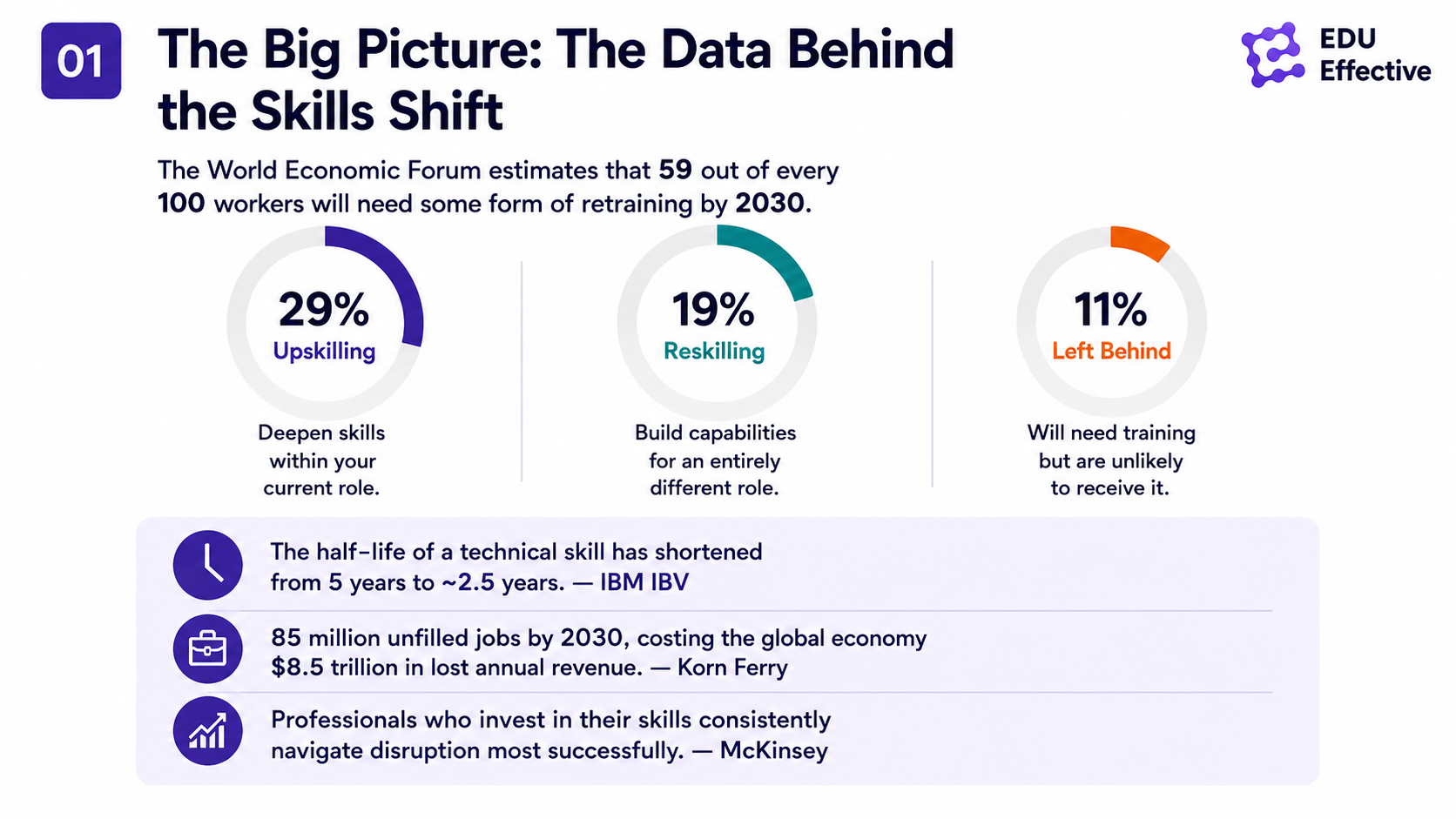
The World Economic Forum estimates that 59 out of every 100 workers will need some form of retraining by 2030. Of those 59, roughly 29 will need to deepen skills within their current role — upskilling. Around 19 will need to build capabilities for an entirely different role — reskilling. And approximately 11 will need training but are unlikely to receive it, representing the human cost of a skills transition that most organisations are handling more slowly than the pace of change requires.
These are not abstract projections. IBM's Institute for Business Value estimates the half-life of a technical skill has shortened from five years to roughly 2.5 years. Korn Ferry projects 85 million unfilled jobs globally by 2030, representing $8.5 trillion in lost annual revenue — not because the jobs don't exist, but because the people who could fill them have not yet developed the skills they require. And McKinsey's research shows that among the professionals who have navigated AI-driven disruption most successfully, the distinguishing factor is not which organisation they worked for — it is how consistently and deliberately they invested in their own skills.
Understanding the difference between upskilling and reskilling is not a semantic exercise. It is the starting point for a skill development strategy that is actually matched to your situation — rather than one designed around what is convenient to offer.
Upskilling: deepening what you already do
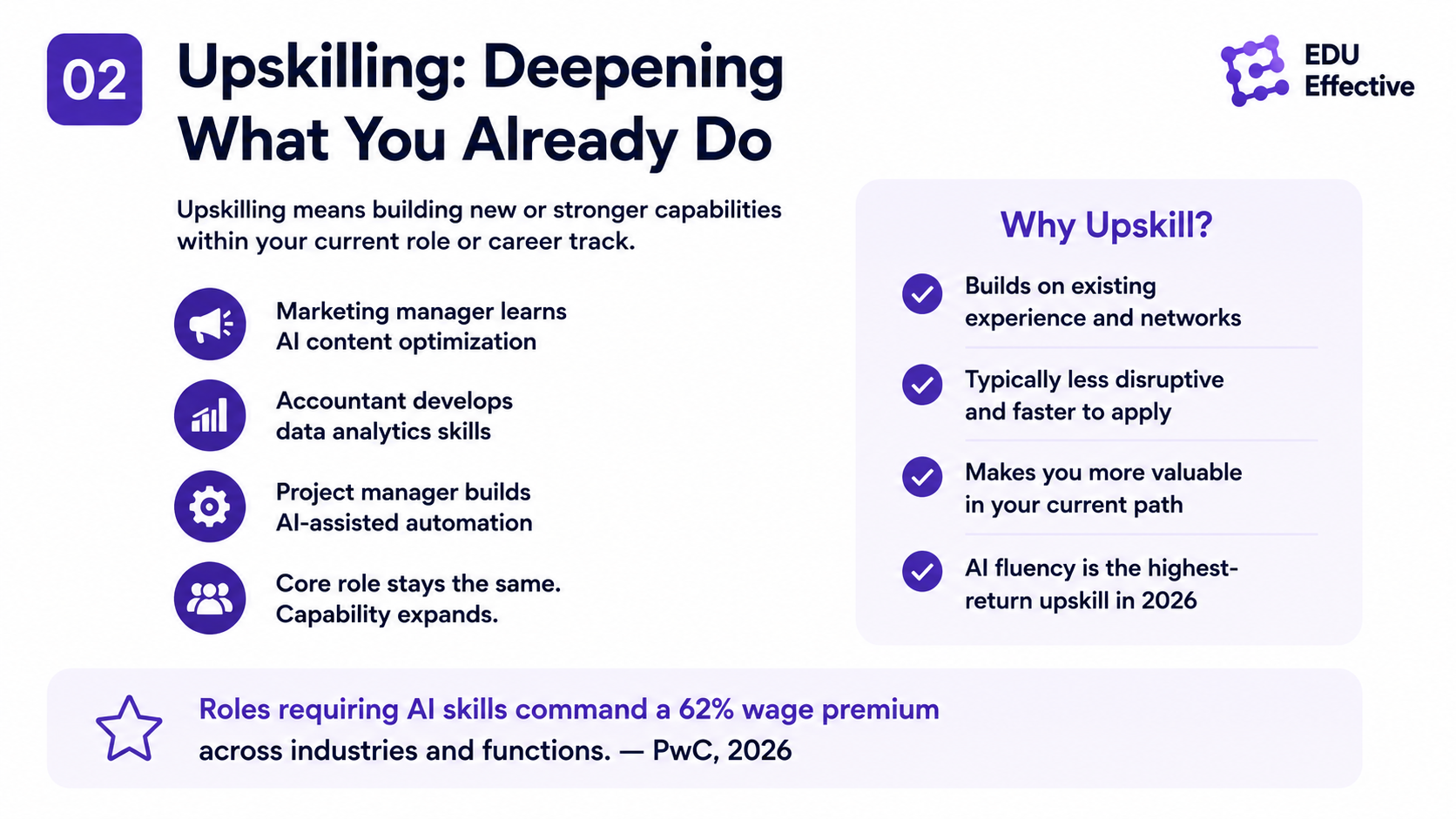
Upskilling means building new or stronger capabilities within your current role or career track. The direction is vertical — you are becoming more capable at what you already do, extending your expertise further along a trajectory you are already on.
A marketing manager who learns AI-powered content optimisation tools is upskilling. An accountant who develops data analytics capabilities to produce more sophisticated financial models is upskilling. A project manager who builds proficiency in AI-assisted workflow automation is upskilling. The core role stays the same; the capability within it expands.
Upskilling is the more common and typically less disruptive of the two. It does not require a professional to reposition themselves in the labour market or change their professional identity. It builds on accumulated experience, existing networks, and current organisational relationships — all of which have value and continue to compound.
In 2026, the most prevalent form of upskilling across industries is AI fluency — the ability to use AI tools intelligently, prompt them effectively, evaluate their outputs critically, and integrate them into existing workflows. PwC's 2026 Global AI Jobs Barometer found that roles requiring AI skills command a 62% wage premium over comparable roles without them. This premium is not limited to technology roles — it applies across marketing, finance, HR, operations, and general management. Here is what upskilling in applied AI actually requires for business professionals — and why the 62% wage premium it commands across marketing, finance, HR, and management makes it the highest-return upskilling direction currently available.
Reskilling: building capabilities for a different role
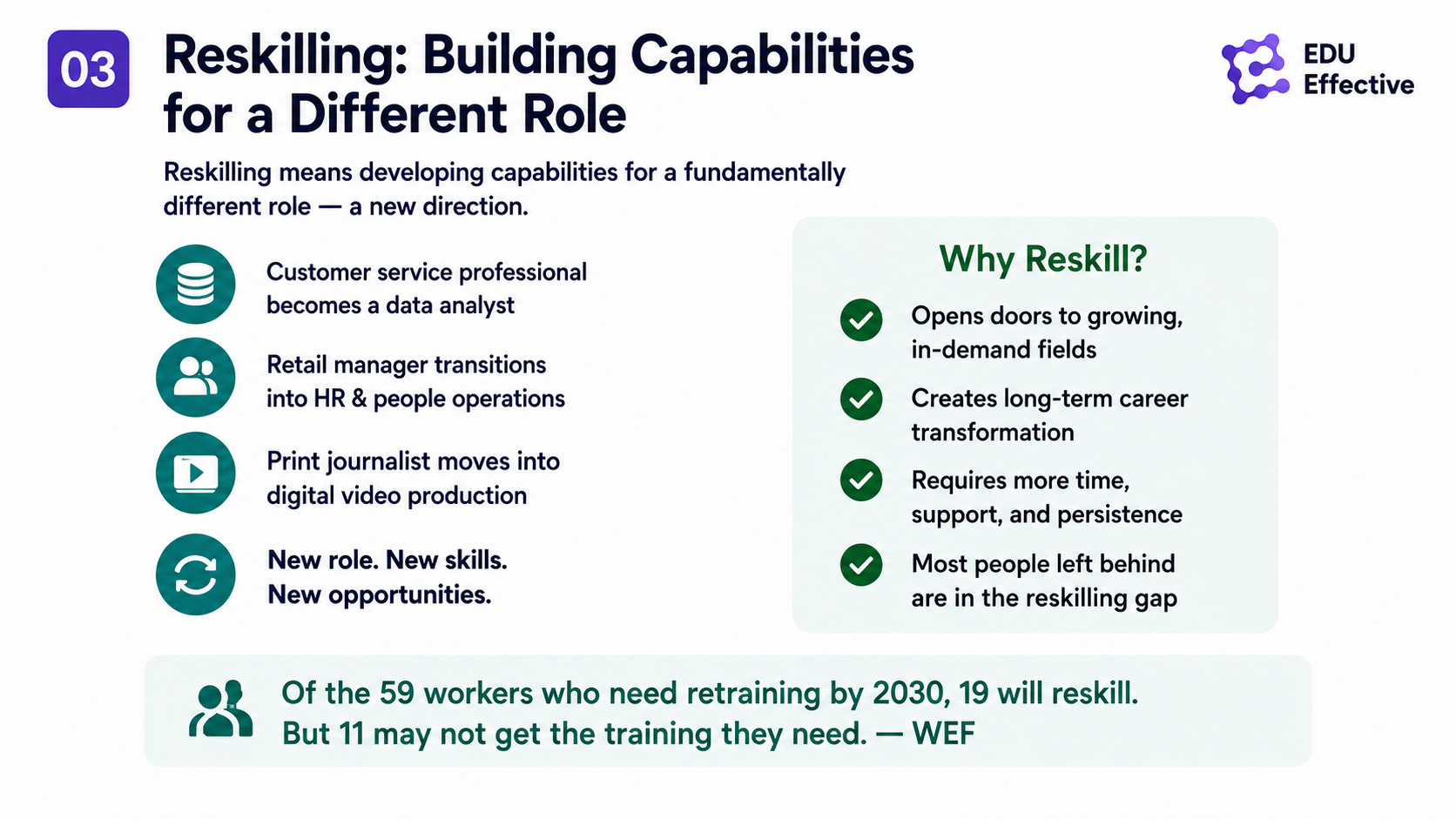
Reskilling means developing capabilities for a fundamentally different role — one that requires a different skill set, not just a deeper version of the current one. The direction is lateral or transitional: moving from one area of work to another.
A customer service professional who retrains as a data analyst is reskilling. A retail manager who transitions into HR and people operations is reskilling. A print journalist who builds digital video and social content production skills to move into video journalism is reskilling. The previous role provides some transferable foundations — work ethic, communication, professional maturity — but the primary capabilities required are new.
Reskilling is more demanding than upskilling, both for the individual and for the organisation supporting them. It requires a longer investment period, stronger motivation to persist through the uncomfortable early stages of unfamiliarity, and a clearer destination to work toward. But it is also more transformative: a well-executed reskilling path can move a professional into a field that is growing and in demand rather than one that is being compressed by automation.
The WEF's breakdown — 29 workers upskilling, 19 reskilling — reflects both the scale of reskilling needed and its relative difficulty. Of the 11 workers who need training but are unlikely to receive it, most are in the reskilling category: they face the largest gaps between current capabilities and available roles, and the least access to the time, resources, and support that would enable them to close those gaps.
The skills half-life problem: why both have become more urgent
For most of the 20th century, a professional could build a skill, deploy it across a career, and expect it to remain relevant for decades. That is no longer a reliable assumption.
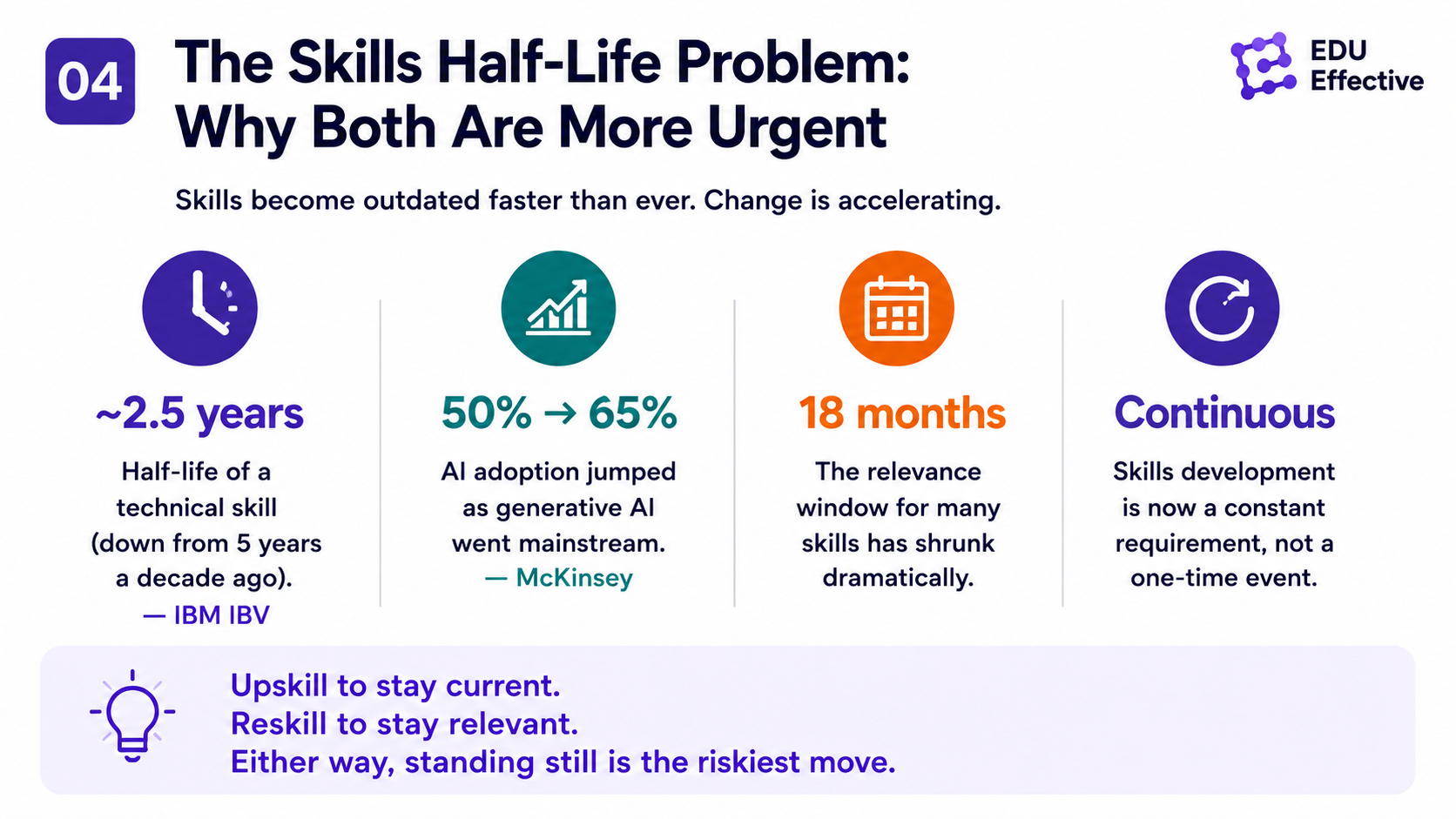
IBM's Institute for Business Value research estimates the half-life of a technical skill at approximately 2.5 years — down from five years a decade ago and fifteen years two decades before that. McKinsey's AI adoption data shows the pace of change accelerating further: AI adoption jumped from around 50% to 65% of organisations once generative AI tools became mainstream, compressing the relevance window on skills that were considered current just eighteen months ago.
The practical consequence is that skills development can no longer be treated as a one-time or occasional investment. It is a continuous requirement — not because employers demand it as a credential, but because the alternative is working with a progressively more outdated skill stack in a market that prices capability in real time.
Gartner's 2026 research found that 64% of IT organisations identify competency gaps as the primary barrier to implementing digital strategy. McKinsey found that fewer than 40% of companies have a clear reskilling strategy. The gap between what organisations need and what their workforces currently offer is widening — and the professionals who are actively closing their own gap, rather than waiting for their employer to close it, are operating in a structurally more advantaged position. This is why structured professional development is the mechanism through which both upskilling and reskilling deliver commercial value — and why the format of learning matters as much as the content it delivers.
How to decide which one you need
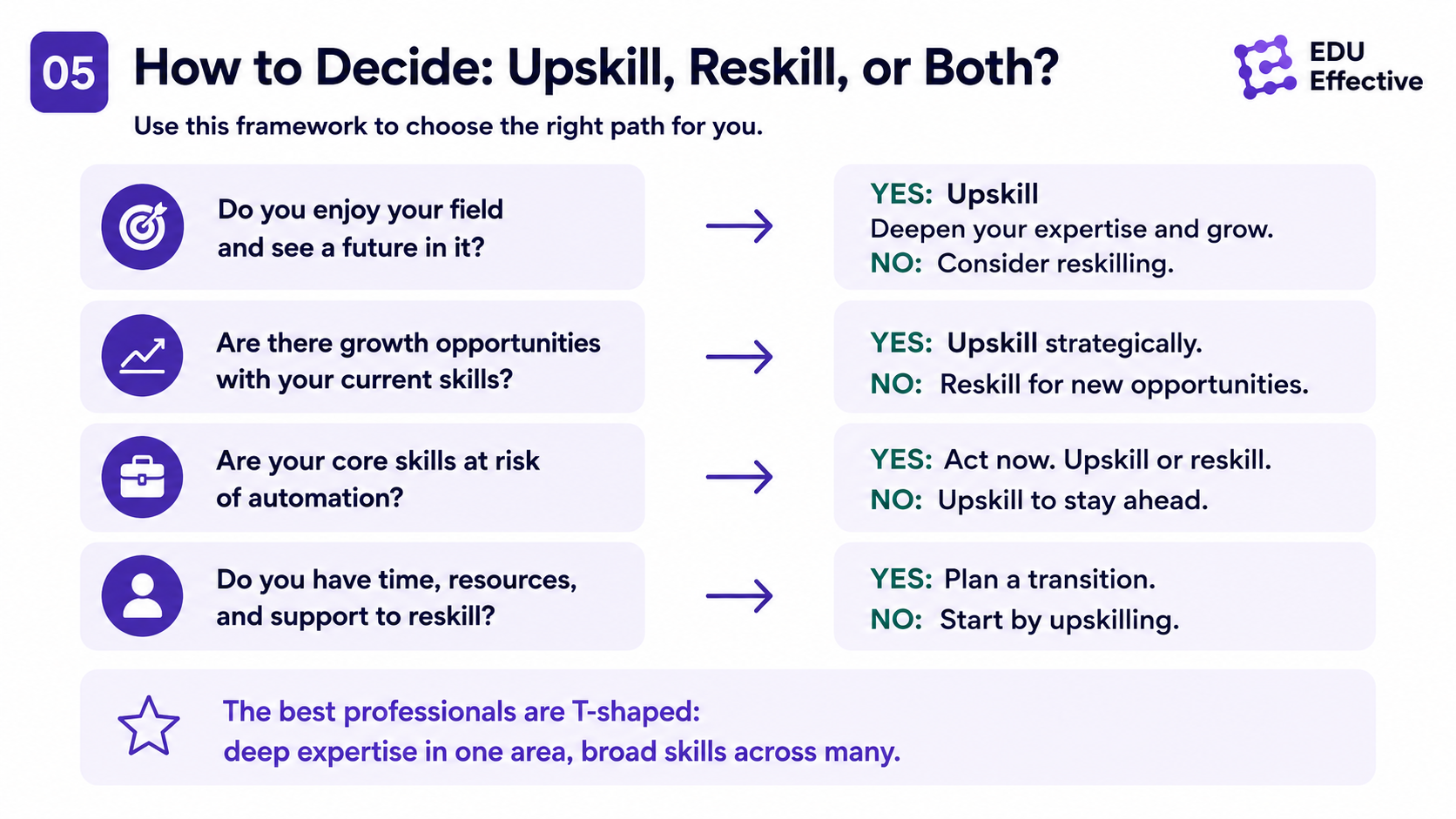
The choice between upskilling and reskilling starts with a clear-eyed assessment of two variables: where your current role is heading, and whether you want to go there.
If your current role is evolving but not disappearing — and you are engaged by the direction it is heading — upskilling is almost certainly the right strategy. Focus on the specific capabilities that are creating premium demand within your function. For most professionals in 2026, that means AI fluency alongside the leadership, communication, and judgement capabilities that AI amplifies rather than replaces. Here is why leadership and management capability is the highest-returning human skill upskilling direction for professionals already in management roles — and what the McKinsey and WEF data on accelerating demand for these skills actually means in practice.
If your current role is being significantly compressed by automation — or if you simply want to move in a different professional direction — reskilling is the appropriate strategy. The critical decision in this case is identifying which capabilities you want to build toward and why. Reskilling without a clear destination is expensive and slow. Reskilling toward a specific role in a growing field, with a structured programme that builds demonstrable capability rather than theoretical knowledge, has a clear pathway to outcome.
If you are unsure, ask yourself one question: would becoming 25-30% more skilled at what you currently do genuinely excite you, and would it move you in a direction that is commercially valuable? If yes, upskill. If not, reskilling deserves serious consideration.
Most professionals need both over the course of a career — sequential upskilling within roles, punctuated by periodic reskilling at career transitions. Treating them as alternatives rather than complements is a false choice: the most professionally resilient people do both, driven by a clear understanding of where the market is heading and an honest assessment of where their current trajectory is taking them. This is how the decision between upskilling and reskilling connects directly to your career advancement trajectory — and why the professionals advancing fastest in 2026 are consistently building skills in the directions with the clearest commercial demand.
Why upskilling is 70-92% cheaper than hiring — and what that means for individuals
From an organisational perspective, the economics of upskilling existing employees compared to hiring externally are well-documented. Studies across industries consistently find that upskilling an existing employee costs between 70% and 92% less than hiring an external candidate to fill the equivalent capability gap — when the full cost of recruitment, onboarding, productivity ramp, and cultural integration are included.
For the individual professional, this creates a specific and underutilised piece of leverage. An employee who proposes their own structured development — targeting capabilities the organisation genuinely needs, with a credible programme and a clear timeline — is presenting their employer with an ROI-positive proposition. The cost of supporting that development is a fraction of the cost of hiring an external candidate with those capabilities. Most professionals never frame their development conversations this way, which means they leave available organisational support on the table.
This framing is particularly effective when the capabilities being developed are in verified high demand — AI literacy, leadership, data analysis, management — where the external hiring market is genuinely tight and the case for developing internal capability is commercially defensible. This is how documented upskilling in verified high-demand capabilities creates the evidence base that makes a salary negotiation credible — and why an employer's 70-92% cost advantage on development versus external hiring gives you more negotiating leverage than most professionals realise.
What effective skill development actually looks like
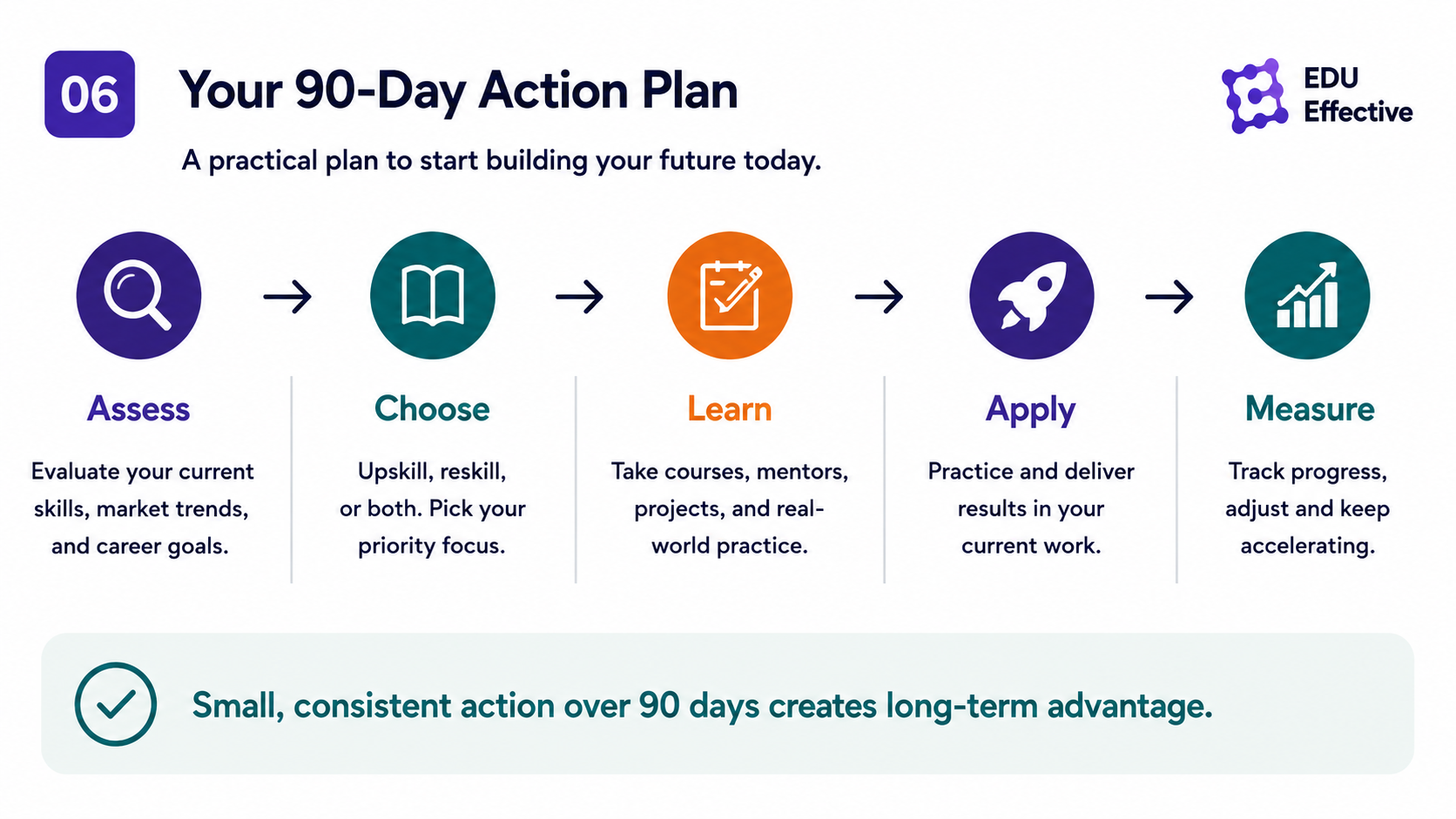
The most common failure mode in both upskilling and reskilling is investing in learning without connecting it to application. LinkedIn's 2025 Workplace Learning Report found that only 15% of employees say their manager helped them build a career plan in the past six months — which means most people are navigating skill development without structured organisational support. And McKinsey's research shows that organisations investing in upskilling without tying it directly to measurable business outcomes rarely sustain those programmes beyond the first budget cycle.
Skills that are learned but not applied within a short window are largely not retained. IBM's research on microlearning found that skills learned in short, focused, regularly repeated sessions with immediate application opportunities are retained at 25-60% higher rates than those learned in longer, less frequent blocks. The format of learning matters as much as the content — for working adults with full professional and personal schedules, a daily learning practice that connects to immediate work application is more effective than occasional intensive study.
The credential question also matters. In a labour market where 78% of employers now use AI tools to screen applications, a qualification that is ASIC-accredited, internationally recognised, and specifically aligned to high-demand capabilities is a more durable investment than a free online course that produces a completion certificate but no verified competency signal.
The WEF's picture — and what it means personally
The WEF's Future of Jobs data provides a map of where the workforce is heading at a macro level. But the 59 workers who need training, the 29 who need upskilling, the 19 who need reskilling — these are aggregate numbers that describe a global population. They do not describe you specifically.
What they do is establish the context. The skills disruption is real, it is accelerating, and it affects professionals at every level and in every function. The 11 workers who need training but are unlikely to receive it are not a different species — they are professionals who did not invest in development until the gap had grown too large to close with available time and resources. The distance between that outcome and a better one is a consistent, deliberate investment in the right skills, started early enough that the gap stays manageable.
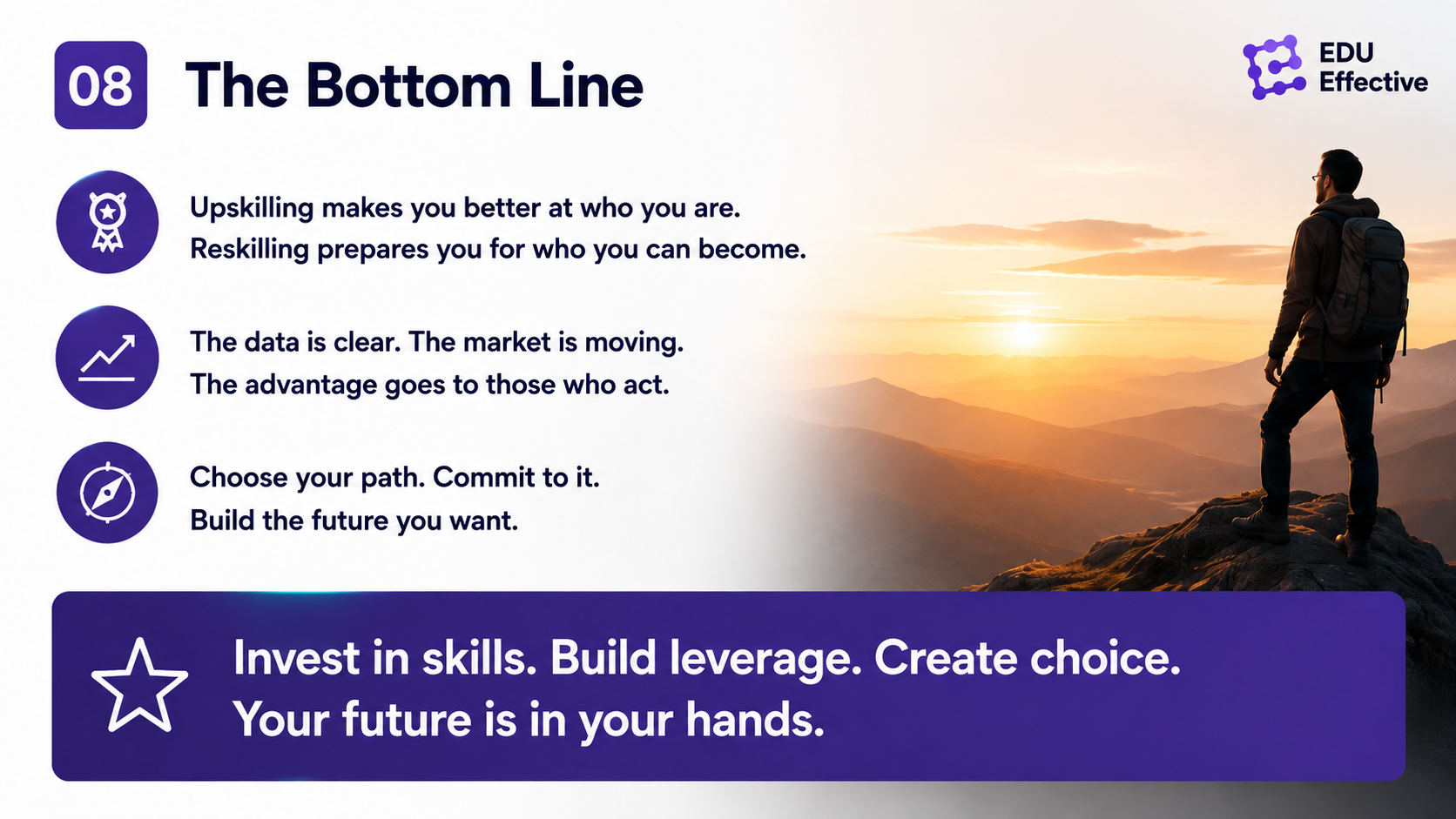
The choice between upskilling and reskilling is ultimately a strategic one — about which direction gives you the best return on the time and effort you invest. Making that choice with clear data about where the market is heading and an honest assessment of where your current trajectory leads is the work that separates professionals who navigate the transition well from those who find it happened to them.
At EDU Effective, our Effective MBA programmes are built precisely for the upskilling and reskilling challenge that working professionals face in 2026 — developing leadership, AI, marketing, and coaching capabilities in 15 minutes a day, without pausing a career to do it. Explore our programs →
At EDU Effective, we build programs for professionals who want to work smarter — not just harder. Explore our programs →
EDU Effective Business School = professional development for your long-term success.
All best-selling Effective MBA programs are built for working adults: 15 minutes a day, 10 months or less, ASIC accredited, from €990.
- Effective MBA: Executive Management & Leadership
- Effective MBA: Applied Artificial Intelligence
- Effective MBA: Coaching, Leadership & Mentoring
- Effective MBA: Mastery in AI
- Effective MBA: Online Marketing
These are professional programmes, not academic ones — built for working adults to apply what they learn directly in their own business, not to collect a scholarly credential.
Join more than 9,000 students in over 120 countries who are investing in their professional development and career success.
Read the experiences of our graduates here.
Apply now — from €990 · Talk to a Study Advisor
Study with NO risk: 14-day money-back guarantee, no questions asked.
Sources
- PwC — 2026 Global AI Jobs Barometer https://www.pwc.com/gx/en/news-room/press-releases/2026/pwc-2026-ai-jobs-barometer.html
- IBM Institute — New IBM study reveals how AI is changing work and what HR leaders should do about it https://www.ibm.com/think/insights/new-ibm-study-reveals-how-ai-is-changing-work-and-what-hr-leaders-should-do-about-it
- World Economic Forum — Future of Jobs Report 2025 https://www.weforum.org/publications/the-future-of-jobs-report-2025/
- Korn Ferry — The Global Skills Crisis: 85 Million Unfilled Jobs by 2030 https://www.kornferry.com/insights/this-week-in-leadership/talent-crunch-future-of-work
- Deloitte — Global Human Capital Trends 2026 https://www2.deloitte.com/us/en/insights/focus/human-capital-trends.html
- Gartner — AI Value Doesn’t Scale Without This CIO Fix https://www.gartner.com/en/articles/ai-talent
- McKinsey & Company — The State of AI https://www.mckinsey.com/capabilities/quantumblack/our-insights/the-state-of-ai
- LinkedIn — Workplace Learning Report https://learning.linkedin.com/resources/workplace-learning-report
- Gallup — State of the Global Workplace 2026 https://www.gallup.com/workplace/349484/state-of-the-global-workplace.aspx