
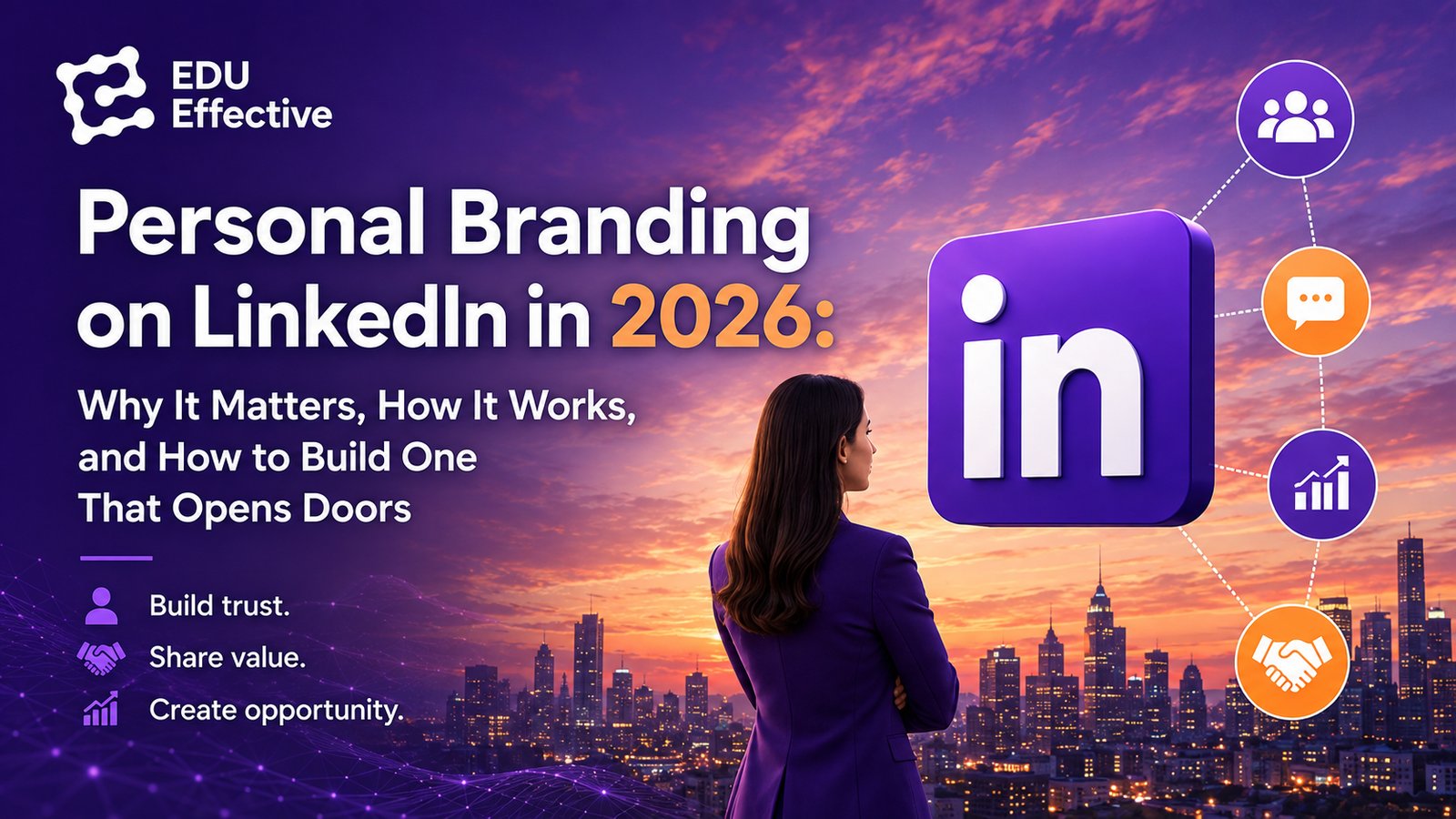

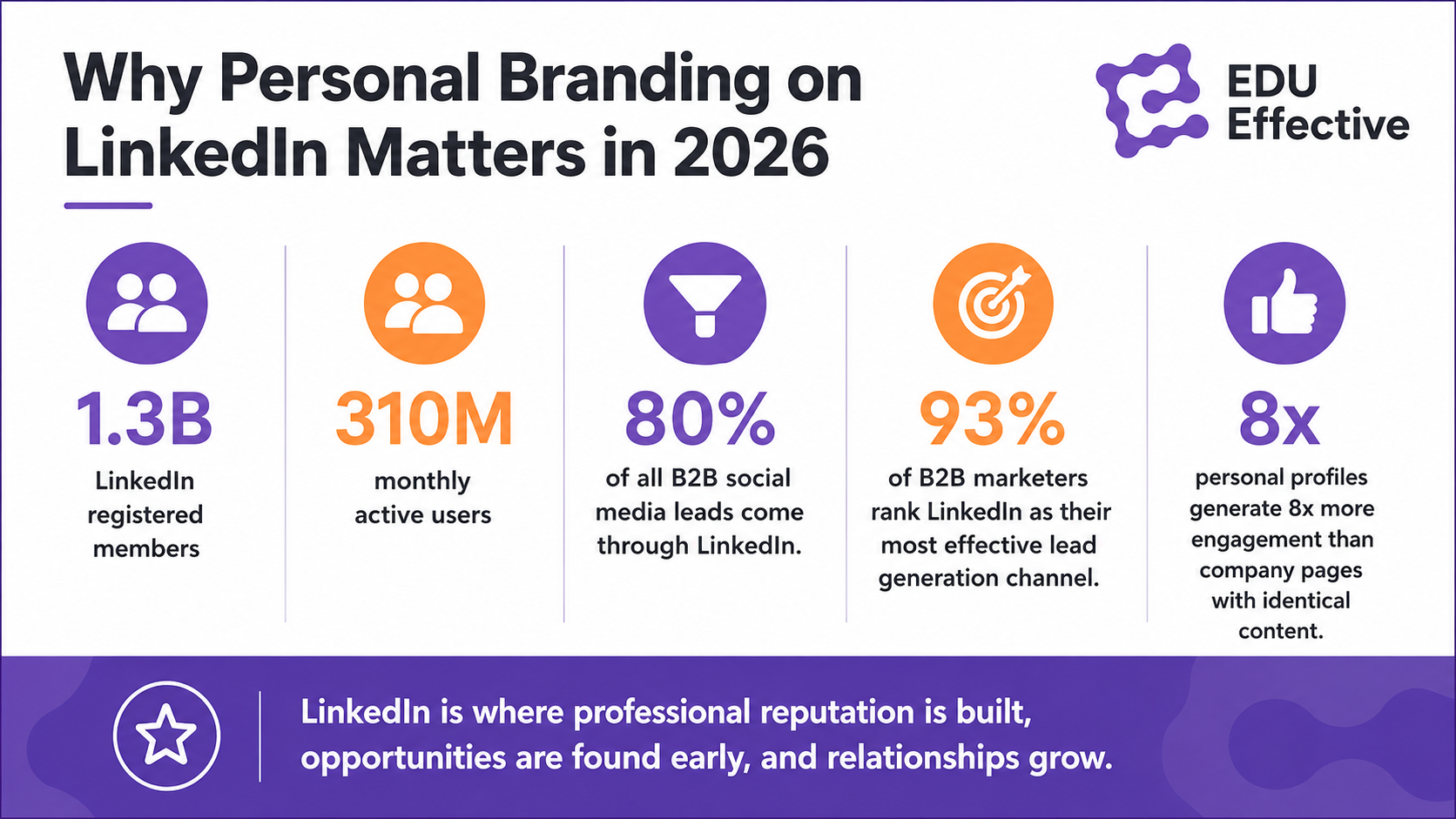
LinkedIn has 1.3 billion registered members and 310 million monthly active users in 2026. 80% of all B2B social media leads come through the platform. 93% of B2B marketers consider it their most effective lead generation channel. And personal profiles generate eight times more engagement than company pages publishing identical content.
These numbers establish one thing clearly: LinkedIn is not one of many professional channels. For anyone in a professional or B2B context, it is the channel — the place where professional reputation is built, opportunities are found before they are publicly posted, and relationships are cultivated across organisations, industries, and geographies.
Personal branding on LinkedIn is the deliberate practice of shaping how you are perceived on that platform — not through self-promotion, but through the consistent demonstration of expertise, perspective, and genuine value to the people you want to reach. Done well, it creates what some practitioners call "opportunity gravity": a situation where opportunities find you rather than requiring you to search for them.
Why personal branding on LinkedIn is no longer optional
The shift from passive profile to active professional presence has been accelerating across every industry and function. Several converging forces have made it structurally important in 2026.
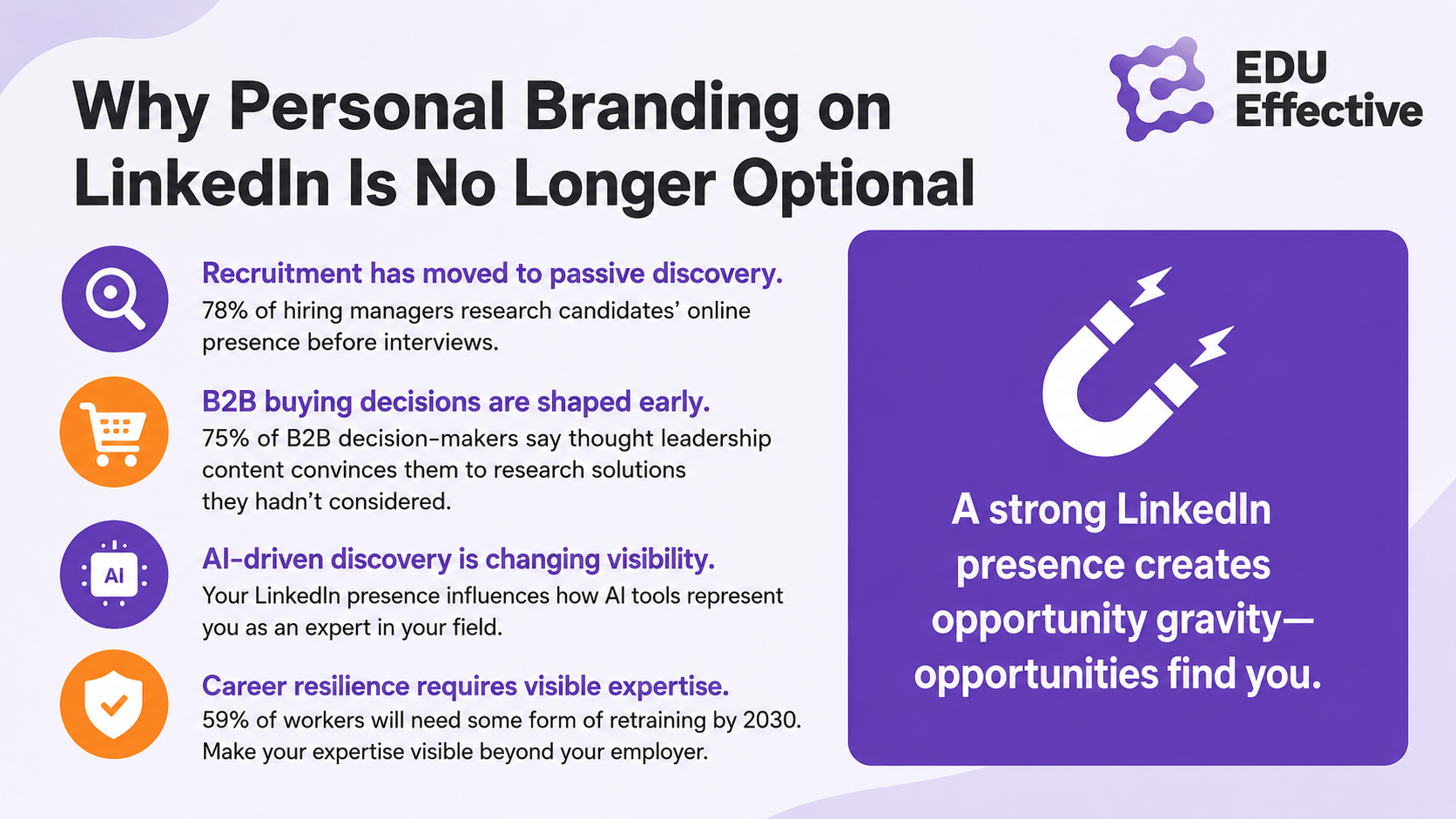
Recruitment has moved to passive discovery. 78% of hiring managers now research candidates' online presence before interviews, according to LinkedIn's 2026 Talent Report data. Recruiters actively search LinkedIn for candidates who match specific skill profiles — and then reach out rather than waiting for applications. Professionals with strong, active profiles field opportunities before positions are publicly advertised. Those with thin or outdated profiles are invisible to this process.
B2B buying decisions are increasingly shaped before first contact. Edelman and LinkedIn's annual B2B Thought Leadership Impact Report — now in its seventh year — consistently shows that thought leadership content influences buying decisions across the full sales funnel. 75% of B2B decision-makers say thought leadership content convinces them to research products or services they were not previously considering. 55% of executives say they use thought leadership to vet organisations they might hire. The professional who is visible and credible on LinkedIn is being considered before any sales conversation begins. how LinkedIn personal branding fits into a broader online marketing strategy — and why 80% of all B2B social media leads flowing through LinkedIn makes profile-level optimisation one of the highest-ROI B2B marketing investments available to any professional or organisation
AI-driven discovery is changing how professionals are found. As AI tools increasingly synthesise professional information from the web, a strong LinkedIn presence contributes to how an individual is represented in AI-generated responses about experts in a field. The professionals who are clearly, consistently, and specifically identified as knowledgeable about a particular domain are the ones who appear in these contexts.
Career resilience requires visible expertise. In a labour market where 59% of workers will need some form of retraining by 2030, and where AI is restructuring role requirements faster than any previous technology transition, the professionals with the most career optionality are those who have built visible, transferable expertise. A personal brand on LinkedIn is the most widely accessible mechanism for making that expertise visible beyond the walls of your current employer. how LinkedIn personal branding connects directly to career advancement in 2026 — and why the 78% of hiring managers researching online presence before interviews makes a strong LinkedIn profile one of the most accessible and durable career advancement investments available how LinkedIn personal branding specifically supports career transitions — and why a well-constructed profile narrative that makes transferable skills visible to the right people is among the most practical steps in a deliberate career change how a strong LinkedIn personal brand strengthens your salary negotiation position — making your market value visible before any compensation conversation begins, and giving your salary anchor the professional credibility that makes it harder to dismiss
The components of a strong LinkedIn profile — what actually matters
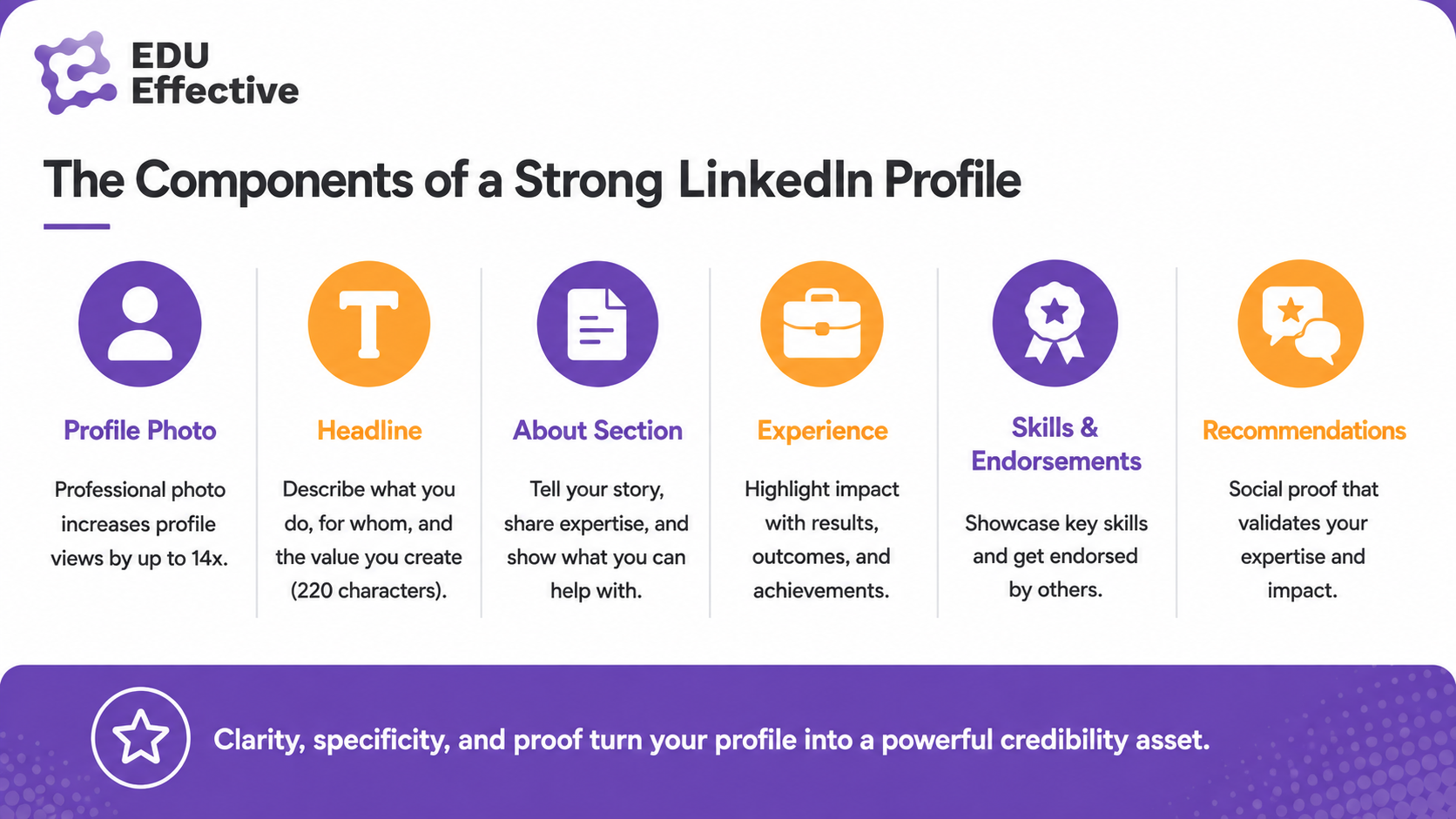
A LinkedIn profile is the foundation of personal branding on the platform. It is what people see when they search for you, click through from content you have shared, or check you out before a meeting. Most profiles are significantly weaker than they need to be — not because professionals lack expertise, but because they have not translated that expertise into profile language that communicates it clearly.
Profile photo. A professional, high-quality headshot increases profile views by up to 14x compared to no photo, according to LinkedIn's own data. The photo should be current, clearly show your face, and convey the professional context you want to be associated with. Background or banner images are the second-most viewed element of a profile and are almost always left at the default by professionals who have not invested in their presence — making a customised banner an immediate differentiator.
Headline. The default LinkedIn headline is your current job title. The effective headline describes what you do, for whom, and what value you create — in the 220 characters available. "Senior Manager at XYZ Corp" tells the reader your employment status. "Senior Manager helping B2B technology companies scale their go-to-market operations | 12 years in enterprise SaaS" tells them what you do, where your expertise lies, and positions you for the conversations you want to have.
About section. The About section is the highest-value real estate on your profile and the most consistently underused. It is the one place where you can write directly to the reader — in first person, in your own voice — about what you do, why you do it, what you have learned, and what you can help people with. The most effective About sections tell a story, demonstrate genuine expertise through specific examples rather than generic claims, and end with a clear indication of what you are open to or available for.
Experience section. Job titles and dates are the minimum. The professionals who use their experience sections effectively describe the specific impact they made in each role — not responsibilities, but outcomes. Revenue generated, teams led, problems solved, capabilities built. This is the evidence that makes the expertise claimed in the headline and About section credible.
Skills and recommendations. LinkedIn's algorithm surfaces profiles based on skill keywords, and profiles with validated skills from recommendations are treated as more credible by both the algorithm and human readers. Requesting specific, substantive recommendations from colleagues and managers who can speak concretely to what you have accomplished produces more value than generic endorsements.
Content strategy: what to publish and how often
The eight-times engagement advantage of personal profiles over company pages is not simply a function of algorithm preference for individuals. It reflects a fundamental difference in how people engage with content from people versus institutions.
People engage with ideas, perspectives, experiences, and stories. They engage with content that teaches them something, challenges their thinking, or resonates with a situation they recognise. Institutional content — product announcements, company news, corporate messaging — rarely does any of these things for most of the audience.
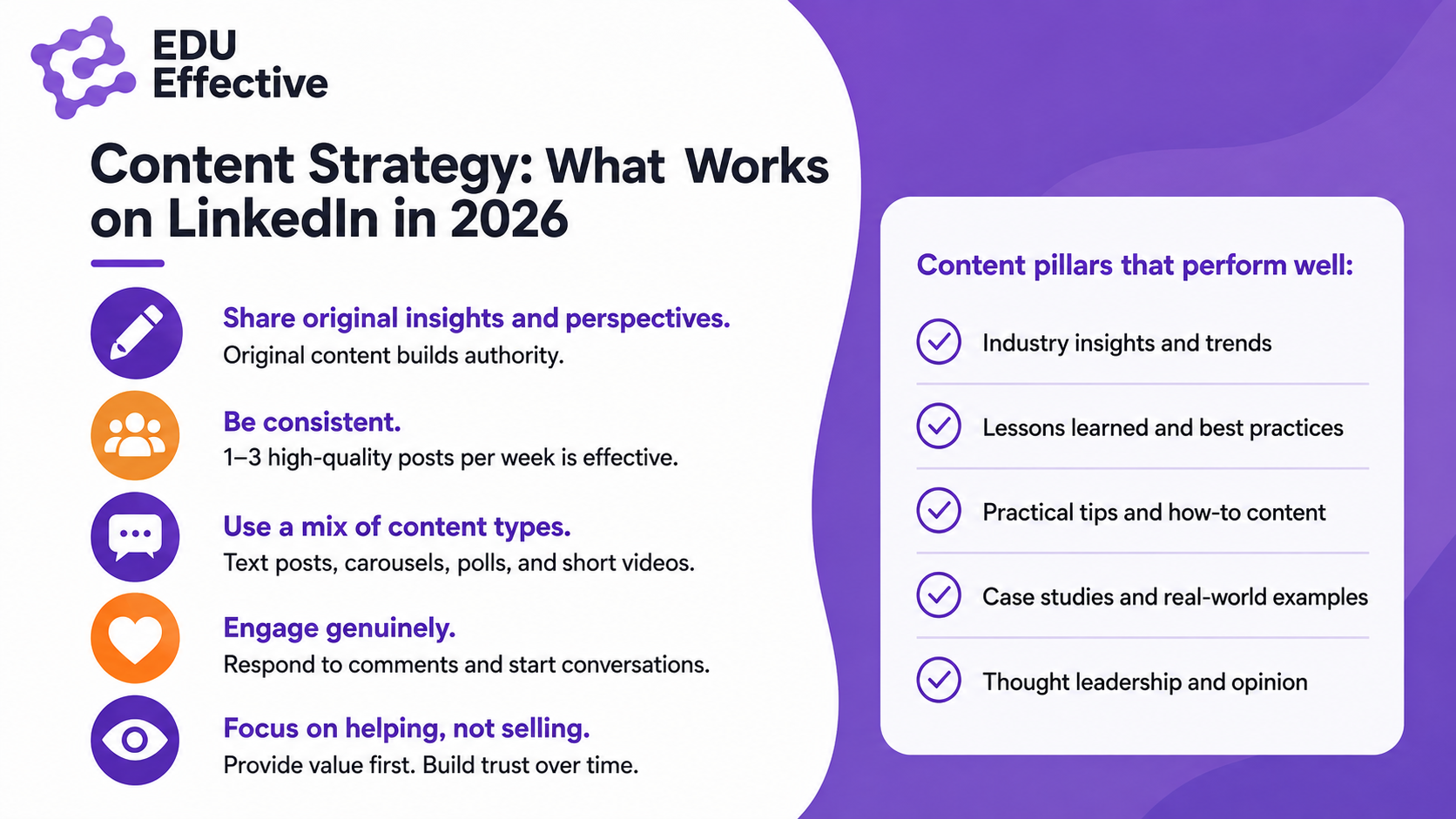
The content that builds personal brand on LinkedIn falls into three broad categories, each serving a different function.
Expertise content demonstrates specific knowledge — an analysis of a recent industry development, a practical framework for solving a common problem, a perspective on a contested question in your field. This is the content that establishes you as someone worth following on a particular topic. It does not need to be long or formally researched. It needs to be specific, grounded in genuine knowledge, and add something that the reader did not already have.
Experience content shares what you have learned from specific professional situations — a difficult decision and how it resolved, a project that did not go as planned and what the lesson was, an observation from a client conversation or a management challenge. This content builds trust because it is honest, and it builds credibility because it reflects experience rather than theory. It is the category that most professionals are most reluctant to publish — because it requires vulnerability and specificity — and the category that consistently generates the highest engagement.
Perspective content takes a clear position on a question that matters in your field. Not a hot take designed to generate controversy, but a genuine professional view on a real debate. The algorithm rewards posts that generate substantive discussion, and substantive discussion is most likely to happen when a post says something specific rather than something that most people already agree with.
How often to post is a more contested question. The data consistently shows that 2 to 4 times per week outperforms daily posting — because quality and consistency matter more than volume, and daily posting leads most people to reduce quality to maintain cadence. LinkedIn's algorithm gives each post a distribution window of roughly 24 to 48 hours, so spreading posts across the week allows each one to be seen rather than competing with itself. how the principles of effective content marketing apply directly to LinkedIn personal branding — including topical authority building, format selection, and the distinction between owned-audience distribution (newsletters) and algorithm-dependent reach
Engagement: the half of personal branding most people neglect
Publishing content is the more visible half of LinkedIn personal branding. The less visible but equally important half is engagement — commenting meaningfully on other people's posts, responding to comments on your own content, and building genuine relationships through the platform's messaging function.
LinkedIn's algorithm weights meaningful comments — defined as substantive responses of more than 15 words — at approximately 12 times the value of a simple like. A comment that adds a perspective, extends an argument, or asks a genuine question contributes significantly to the distribution of the original post and signals to the algorithm that the commenter is an active, engaged professional worth surfacing.
The strategic benefit of consistent, meaningful engagement is relationship-building at scale. Commenting regularly on the posts of people in your target network — potential clients, employers, collaborators, or thought leaders in your field — creates familiarity before any direct outreach. When you eventually send a connection request or a message, you are not a stranger.
Thought leadership at scale: the LinkedIn newsletter
LinkedIn newsletters grew 150% year over year to reach 450 million subscribers in 2026, making them the platform's fastest-growing content format. For professionals building personal brands, newsletters represent a specific strategic advantage: subscriber lists are owned rather than algorithm-dependent, meaning each new issue is delivered directly to subscribers rather than competing for feed visibility. how LinkedIn newsletters combine the platform's distribution reach with the owned-audience model of email marketing — and why the 150% year-over-year subscriber growth makes them the fastest-moving format for professionals building durable presence independent of feed algorithm changes
A LinkedIn newsletter works best when it covers a specific topic consistently — the same topic that your profile and regular content establish you as expert in — and delivers genuine insight rather than a content aggregation. The professionals building the most influential newsletters are those who share specific analysis, original perspectives, and practical knowledge that readers cannot easily find elsewhere.
Consistency matters more than frequency for newsletters. A monthly newsletter published reliably over two years builds an audience more effectively than a weekly newsletter published for three months before the cadence becomes unsustainable.
What personal branding on LinkedIn is not
Personal branding is sometimes conflated with self-promotion, and the conflation is worth addressing directly — because it is what stops many competent professionals from investing in their presence.
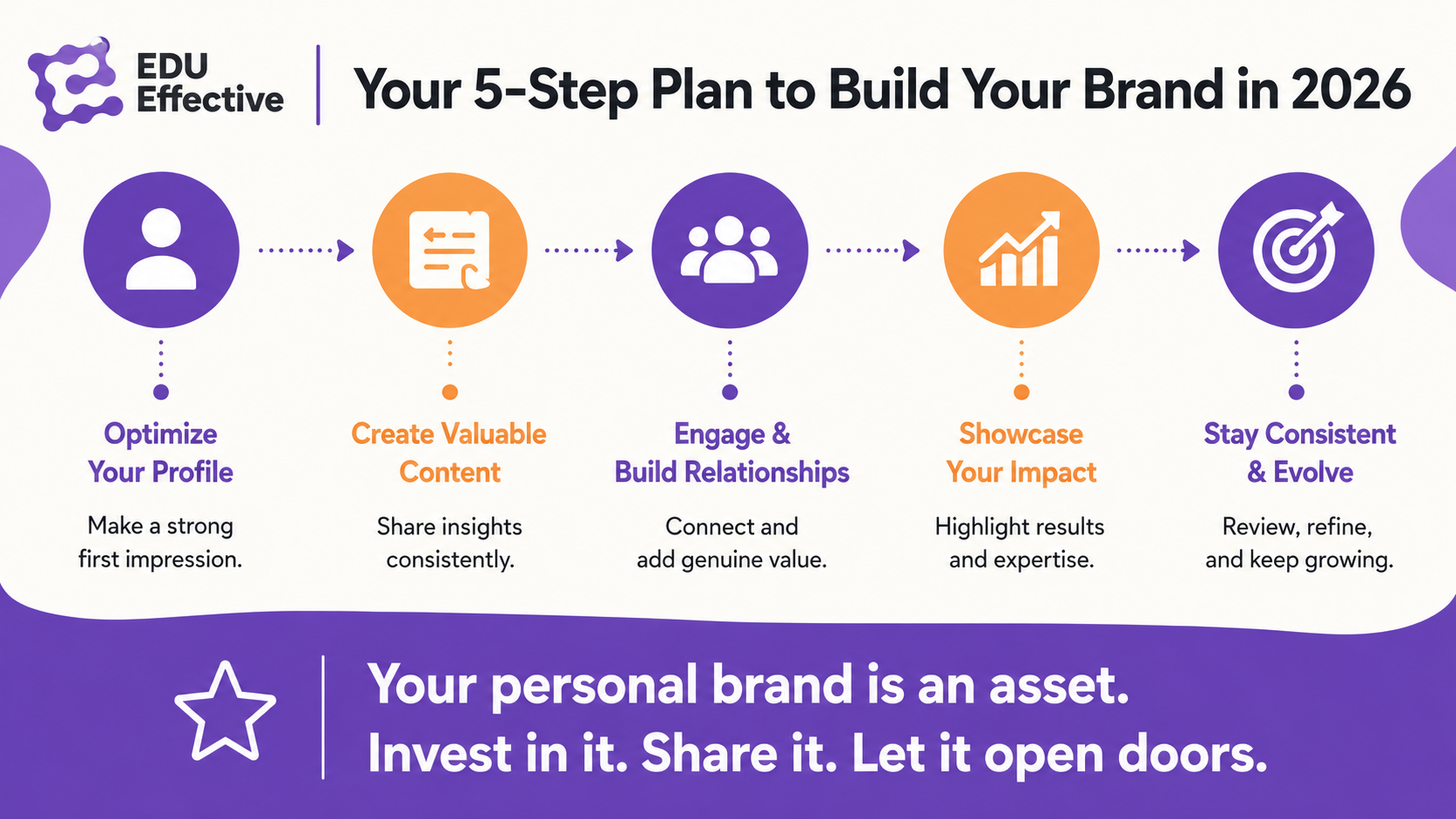
Self-promotion is claiming to be excellent. Personal branding is demonstrating expertise through the consistent sharing of genuine value. The former is unconvincing and frequently embarrassing. The latter is professionally useful and builds trust over time.
The LinkedIn content that generates credibility is specific, honest, and grounded in real experience. Generic motivational posts, vague claims about being "passionate about results," and corporate messaging that could have been written by anyone do not build personal brands — they are the signal that a professional has not yet understood what the platform rewards.
The professionals whose LinkedIn presence consistently generates career opportunities, client relationships, and professional recognition are those who have committed to sharing genuine expertise over time — not those who have found the most efficient way to appear impressive without saying anything specific.
At EDU Effective, the Effective MBA: Online Marketing develops personal branding alongside the full digital marketing skill set — including content strategy, analytics, social media marketing, and AI tools. Explore the programme →
EDU Effective Business School — professional development for your long-term success.
All five Effective MBA programs are built on the same educational model — designed for working adults who need learning that fits real professional life:
- Effective MBA: Executive Management & Leadership
- Effective MBA: Applied Artificial Intelligence
- Effective MBA: Coaching, Leadership & Mentoring
- Effective MBA: Mastery in AI
- Effective MBA: Online Marketing
Every programme runs on 15 minutes a day, completes in 10 months or less, is ASIC accredited, and starts from €990.
These are professional programmes, not academic ones — built for working adults to apply what they learn directly in their own business, not to collect a scholarly credential.
Join more than 9,000 students in over 120 countries who are investing in their professional development and career success. Read the experiences of our graduates here.
Apply now — from €990 · Talk to a Study Advisor
Study with NO risk: 14-day money-back guarantee, no questions asked.
Sources
- LinkedIn — Platform Statistics and Talent Report 2026 https://learning.linkedin.com/resources/talent-velocity-report
- Edelman / LinkedIn — 2025 B2B Thought Leadership Impact Report (2,000 global professionals) https://www.edelman.com/expertise/Business-Marketing/2025-b2b-thought-leadership-report
- Edelman — Trust Barometer 2025 https://www.edelman.com/trust/2025/trust-barometer
- LinkedIn — B2B Thought Leadership Research: Reach Beyond the Ready https://www.linkedin.com/business/marketing/blog/research-and-insights/b2b-thought-leadership-research-impact-linkedin-edelman
- Hootsuite — LinkedIn Statistics and Benchmarks 2026 https://blog.hootsuite.com/linkedin-statistics-business/
- HubSpot — LinkedIn Marketing Statistics 2026 https://www.hubspot.com/marketing-statistics