

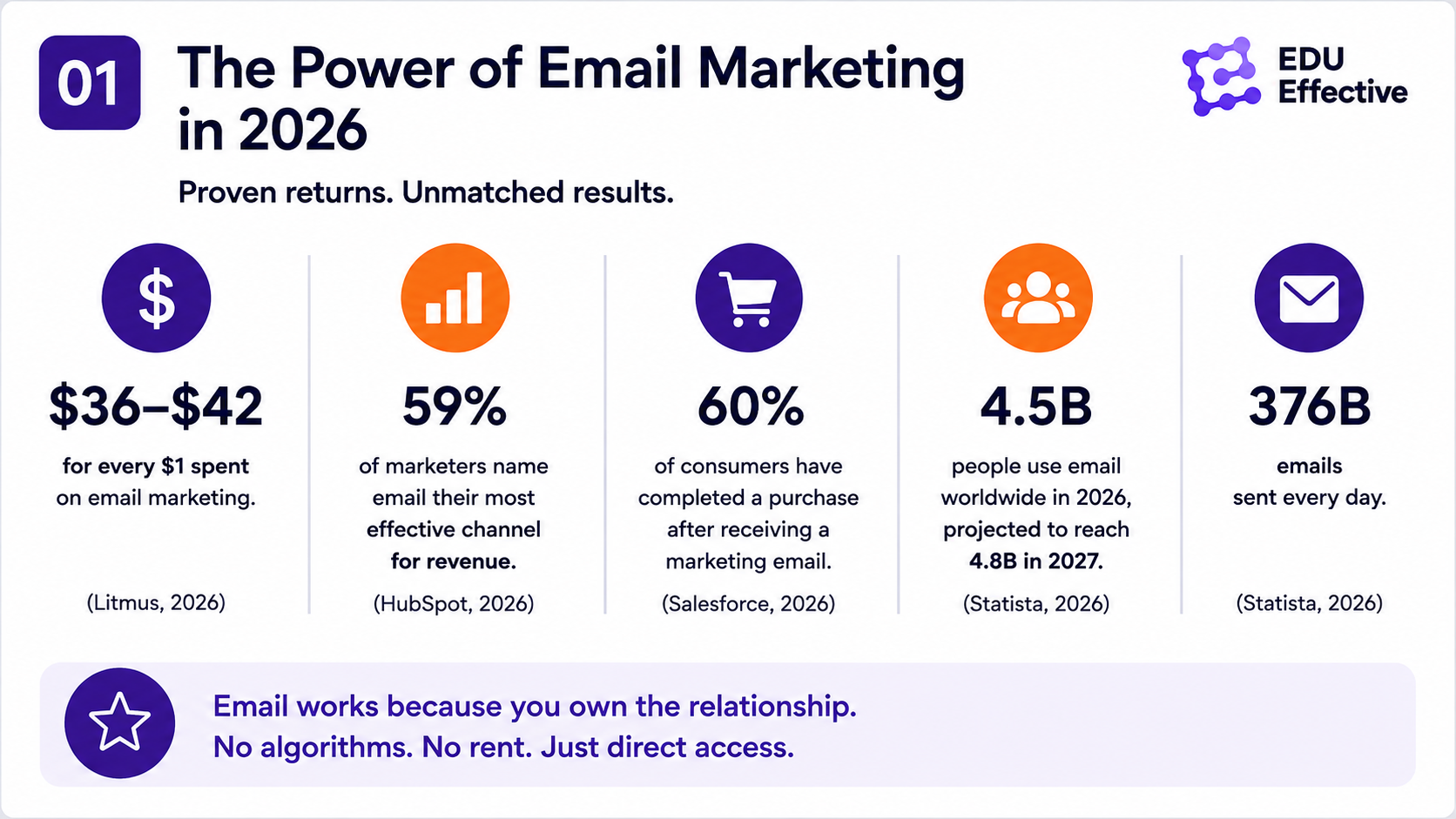
Email marketing delivers $36 to $42 for every $1 spent. That figure from Litmus's research is frequently cited — and frequently dismissed by marketers chasing newer channels — but it continues to be confirmed by independent research year after year. For context: paid search delivers approximately $2 per $1 spent. Social advertising delivers around $2.80. Display advertising delivers $1.35.
No other digital marketing channel consistently produces comparable returns at scale. 59% of marketers name email their most effective channel for revenue generation — above social media at 14% and paid search at 12%, according to HubSpot's State of Marketing 2026. And 60% of consumers have completed a purchase after receiving a marketing email, according to Salesforce research. For the full picture, see how email marketing fits into a comprehensive online marketing strategy — and why it consistently outperforms every other digital channel on ROI across all major benchmark studies in 2026.
The reason email continues to outperform on ROI is structural, not tactical. Email operates on an owned audience — people who have explicitly opted in to hear from you, who you can reach directly without platform algorithm mediation, and whose relationship with your brand you can build systematically over time. Every other digital channel rents audience attention. Email owns it. For content creators, this is also how email marketing integrates with a broader content marketing strategy — and why owned audience distribution through email is the single most reliable way to ensure content reaches the audience it was built for, independent of algorithm changes on any platform.
Why email marketing is not dying — it is maturing
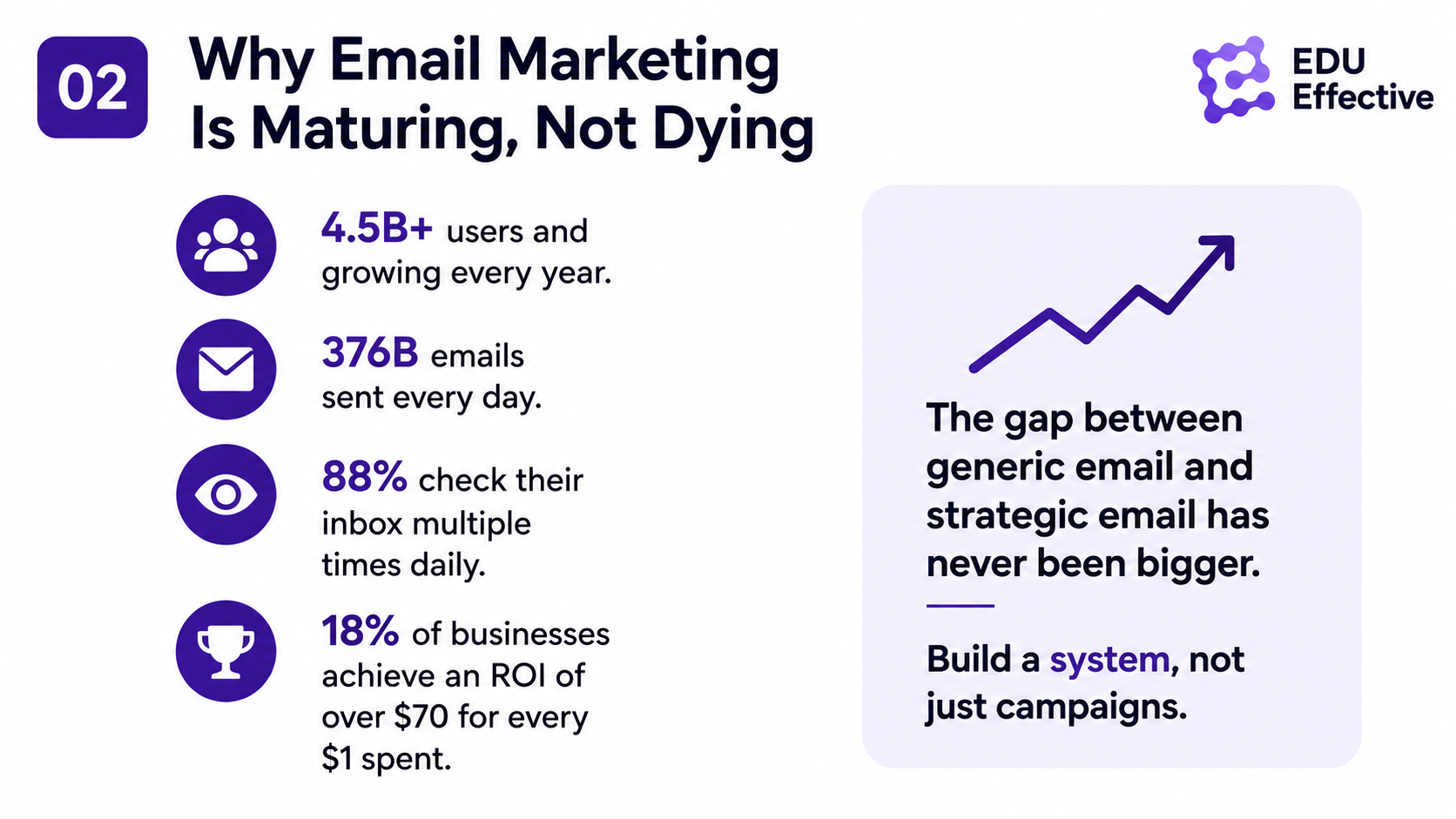
The "email is dead" prediction resurfaces every few years, typically triggered by the rise of a new channel. Social media was going to replace email. Then messaging apps. Then social commerce. None did. Email's user base has grown consistently: 4.5 billion people use email worldwide in 2026, projected to reach 4.8 billion by 2027, according to Statista. 376 billion emails are sent every day. 88% of email users check their inbox multiple times daily.
What has changed is not email's relevance but the sophistication required to use it effectively. Generic broadcast emails to undifferentiated lists produce declining results — not because email does not work, but because the gap between generic email and well-segmented, well-personalised, well-automated email has widened considerably. The marketers capturing the highest returns are those who have built email as a system rather than a campaign channel.
The distinction matters. A campaign is a one-time effort with a start and end date. A system is an ongoing infrastructure — list building mechanisms, segmentation logic, automated flows, and measurement frameworks — that generates returns continuously without requiring constant manual intervention. Building that system is what separates the 18% of businesses achieving an ROI of over $70 for every $1 spent from those producing average returns.
The foundation: list building done correctly
Every email strategy begins with a list — and the quality of that list determines everything that follows. A large list of disengaged or uninterested subscribers produces poor deliverability, low engagement rates, and ultimately damages the sender reputation that determines whether future emails reach inboxes at all. A smaller list of genuinely interested, actively engaged subscribers produces consistently better commercial outcomes.
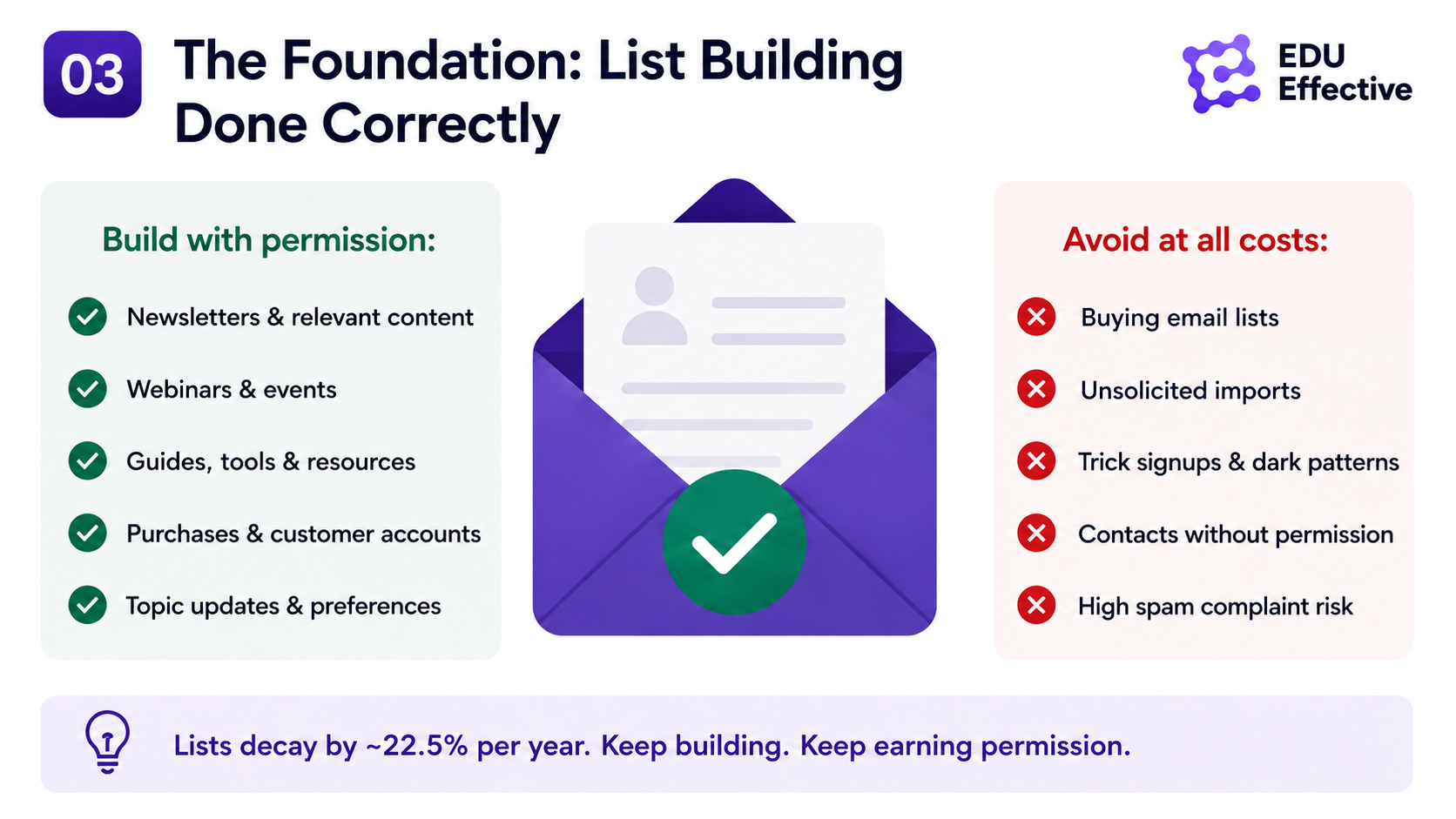
The principle behind effective list building is permission — people who actively choose to receive communications from you because they perceive value in doing so. This means collecting email addresses through mechanisms that create genuine expectation: subscribing to a newsletter for relevant content, registering for a webinar or event, downloading a guide or tool, completing a purchase, or opting in for updates on a topic they care about.
What it should not mean is purchasing email lists, importing contacts who have not specifically opted in to your communications, or using dark patterns that trick people into subscribing without clear understanding. Beyond the regulatory requirements of GDPR, the CAN-SPAM Act, and equivalent legislation in most markets, contacts who did not choose to receive your emails are contacts who will not open them — and whose spam complaints will damage your ability to reach the contacts who did choose to.
Email lists decay naturally by approximately 22.5% per year as people change addresses, switch jobs, and lose interest, according to HubSpot research. List building is therefore not a one-time activity but a continuous process. Signup opportunities at every relevant touchpoint — content downloads, checkout flows, webinar registrations, support interactions — compound over time into a list that grows faster than it decays. It is also why email marketing is among the highest-returning channels for organisations investing in professional development content — and how the owned audience model compounds in value in ways that paid distribution cannot replicate.
Segmentation: why sending the same thing to everyone is the most expensive mistake in email
The default email strategy for most organisations is broadcasting — sending the same message to everyone on the list at the same time. It is operationally simple. It is also consistently the approach that produces the lowest engagement and the highest unsubscribe rates.
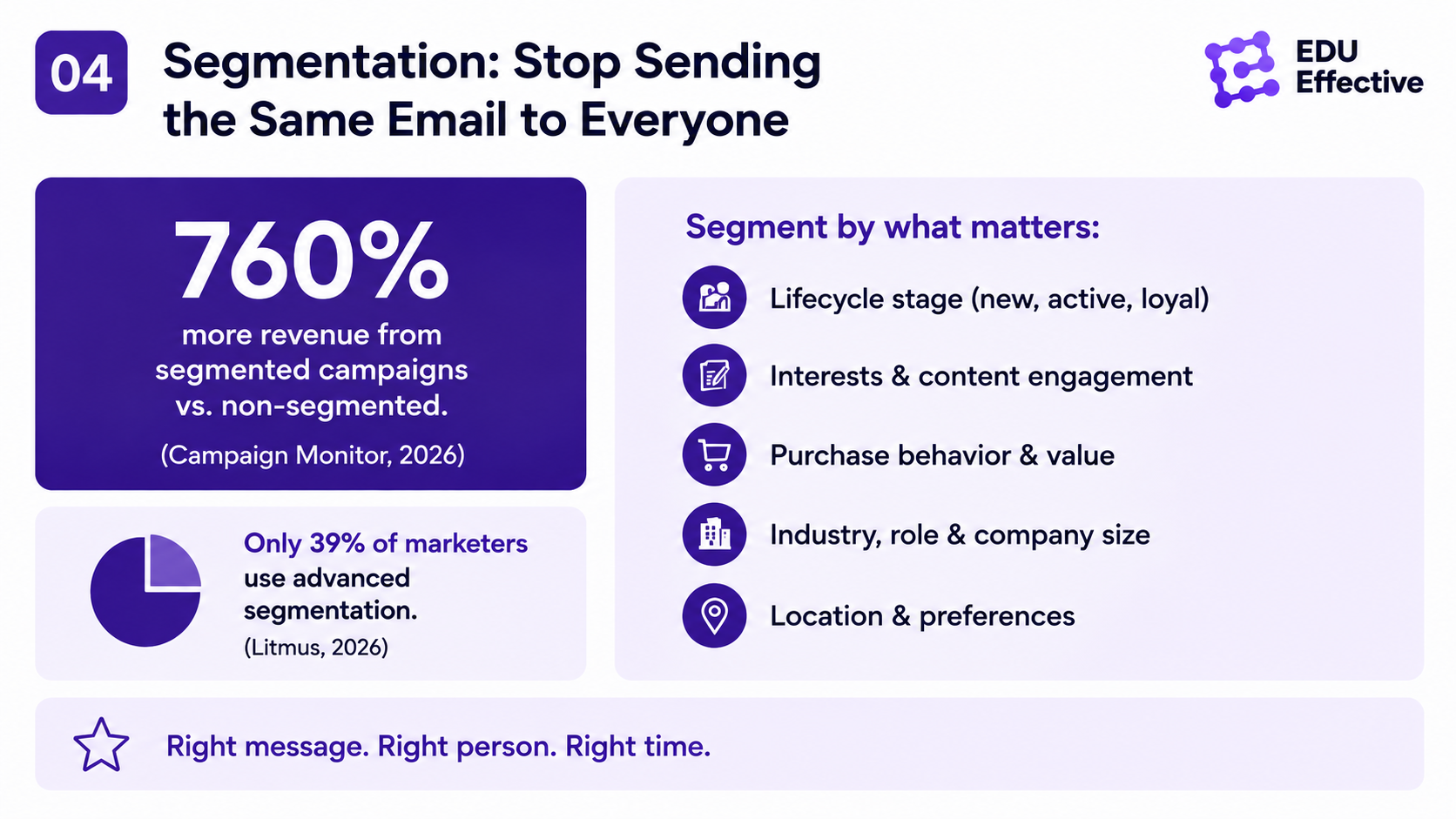
Segmented campaigns generate 760% more revenue than non-segmented campaigns, according to Campaign Monitor research. Yet only 39% of email marketers apply advanced segmentation, according to Litmus's State of Email 2026. The gap between what segmentation delivers and how widely it is practised is one of the largest unrealised opportunities in digital marketing.
Segmentation means dividing your list into groups whose members share relevant characteristics — and sending different messages to different groups based on those characteristics. The most effective segmentation approaches in 2026 align with where subscribers are in their relationship with your brand.
New subscribers who have just joined your list have different needs from long-term customers who have purchased multiple times. Prospects who downloaded a guide about a specific topic have signalled an interest that warrants follow-up on that topic specifically. Customers who have not purchased in 90 days may benefit from a re-engagement sequence. High-value customers who purchase frequently deserve recognition and early access that rewards their loyalty.
Starting segmentation does not require sophisticated technology. Even simple behavioural segmentation — dividing subscribers by whether they opened your last three emails — allows you to send more relevant communications to engaged subscribers while running a separate re-engagement campaign for those who have gone quiet.
Automation: the infrastructure that generates revenue while you sleep
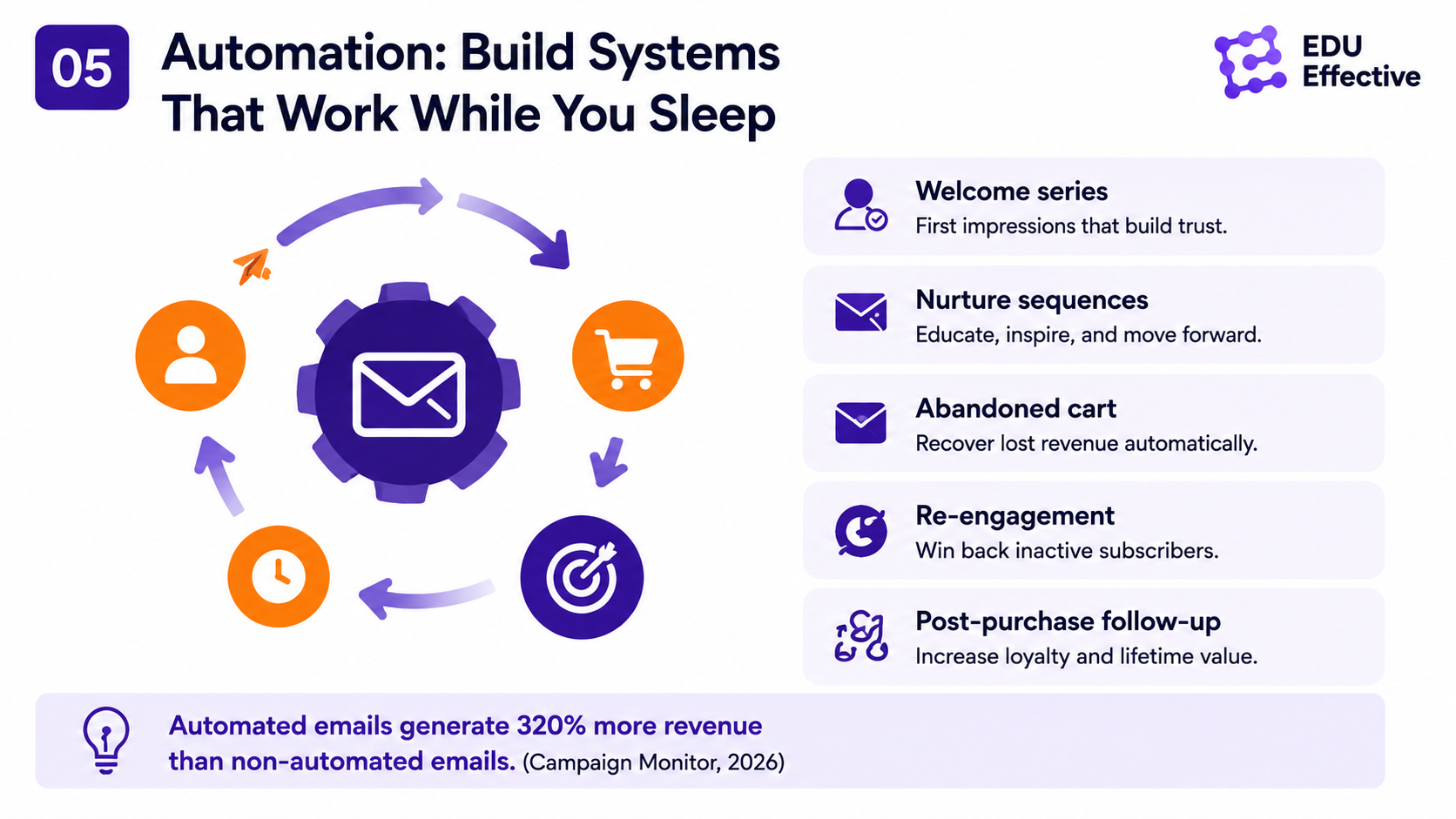
Automated email sequences — triggered by specific subscriber behaviours rather than scheduled manually — are the highest-leverage investment in email marketing for most organisations. Automated emails drive 320% more revenue than non-automated emails, according to Campaign Monitor. Automated sequences account for 37% of email-generated sales despite representing only 2% of total email volume sent, according to Omnisend research.
The commercial logic is straightforward: automated sequences respond to subscriber behaviour at the moment that behaviour occurs, when the recipient's intent and interest are highest. A welcome email sent within minutes of someone subscribing reaches them at peak engagement. An abandoned cart email sent within an hour of cart abandonment catches the majority of recoverable purchases. A post-purchase sequence sent immediately after a first order builds the relationship that determines whether that customer purchases again.
The five automated sequences that deliver the highest commercial returns for most businesses are:
Welcome sequence — the three to five emails sent to new subscribers in the first two weeks after they join your list. Welcome emails generate 320% more revenue per email than other promotional emails, according to Mailchimp research. They set expectations, establish brand voice, and begin building the relationship that determines long-term subscriber value. A subscriber who engages with your welcome sequence is significantly more likely to purchase than one who does not.
Abandoned cart sequence — triggered when a visitor adds items to a cart and leaves without purchasing. Recovery rates of 5-15% of abandoned carts are achievable with well-structured sequences. Given that cart abandonment rates across e-commerce average over 70%, this is one of the highest-ROI automations available for consumer-facing businesses.
Post-purchase sequence — emails sent after a first purchase that welcome the customer, explain what to expect, provide relevant information about their purchase, and begin building the relationship that generates repeat purchases. The probability of selling to an existing customer is 60-70%, versus 5-20% for a new prospect, according to Salesforce research. Post-purchase sequences are the primary mechanism for capturing that probability.
Re-engagement sequence — targeted at subscribers who have not opened emails in 60 to 90 days. Attempting to re-engage inactive subscribers before removing them is both commercially sensible and important for deliverability: a list with high proportions of inactive subscribers produces lower engagement signals that damage sender reputation for the active subscribers too.
Lead nurture sequence — for B2B contexts especially, a structured sequence that delivers valuable content to prospects over weeks or months, building familiarity and trust before a purchase decision is appropriate. B2B buyers consume an average of three to seven pieces of content before contacting a sales team. A lead nurture sequence delivers that content systematically rather than leaving it to chance. This is also the marketing funnel stage where email marketing produces its most critical impact — and why lead nurturing is the practice that determines whether 79% of leads exit or convert.
For teams adding AI to these workflows, how AI implementation in email marketing illustrates the broader principle that technology accounts for 20% of the value while workflow redesign accounts for 80% — and what that means for building AI into an email programme that was previously running manually.
Personalisation: from first name to genuine relevance
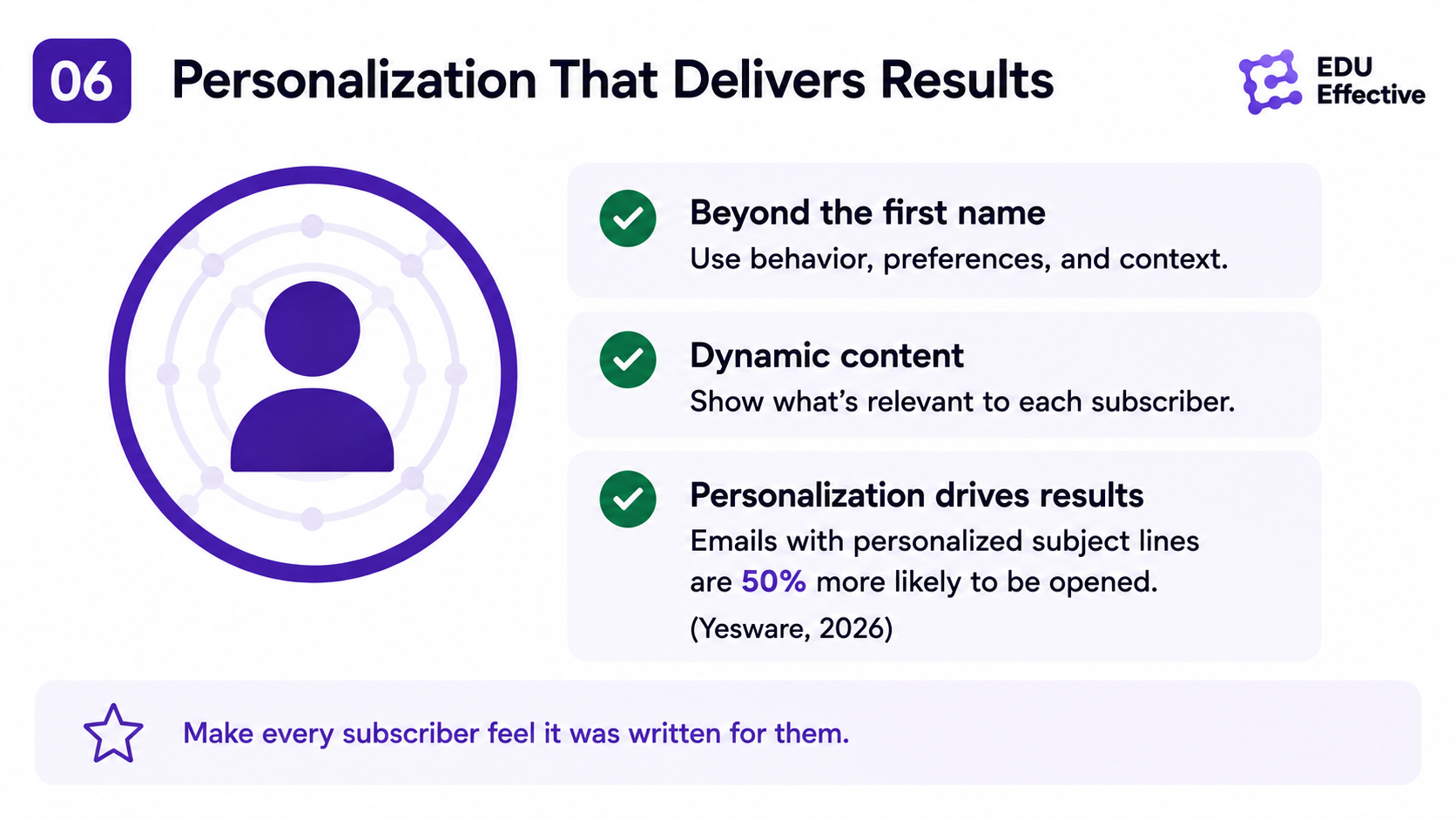
Personalisation is one of the most overused terms in email marketing and one of the most underexploited practices. Including a subscriber's first name in a subject line is personalisation. It increases open rates by approximately 26% according to Campaign Monitor research. But it is the least sophisticated form of personalisation available — and the marketers treating it as the destination rather than the starting point are leaving significant returns unrealised.
Genuine personalisation in 2026 means adapting email content based on what you actually know about each subscriber: their purchase history, their browsing behaviour, their stated preferences, their stage in the customer lifecycle, their engagement patterns with previous emails. Product recommendations based on purchase history increase CTR by approximately 45% compared to generic recommendations, according to HubSpot's personalisation research. Location-based content increases conversion rates by approximately 29%.
McKinsey's research on personalisation across marketing channels found that companies excelling at personalisation generate 40% more revenue than average performers. The email channel is where personalisation has the most direct and measurable commercial impact — because email is the channel where you know the most about each individual recipient. It also connects directly to how email personalisation connects to the broader hyper-personalisation trend reshaping marketing in 2026 — and why McKinsey's finding that personalisation leaders generate 40% more revenue applies most directly and measurably to the email channel.
AI has made advanced personalisation accessible at scale. AI-generated subject lines outperform human-written equivalents by 26% on average, according to 2026 benchmarks. Dynamic send-time optimisation — sending each subscriber their email at the time they are most likely to open, based on their historical behaviour — adds a further 14% lift when combined with AI-optimised subject lines. By late 2026, 61% of enterprise email programmes use AI for at least one element of campaign creation, according to current research. For a deeper treatment, see what applied AI means for email marketing specifically — from subject line optimisation that outperforms human-written equivalents by 26% to dynamic send-time selection and personalisation at a scale that manual approaches cannot sustain.
Deliverability: the technical foundation everything else depends on
The most perfectly written, most precisely segmented, most intelligently automated email produces zero results if it does not reach the inbox. Deliverability — the likelihood that emails you send actually arrive in recipients' inboxes rather than being filtered to spam or blocked — is the technical foundation that all email marketing strategy depends on.
The primary factors affecting deliverability in 2026 are authentication, list hygiene, and engagement metrics.
Authentication — implementing SPF (Sender Policy Framework), DKIM (DomainKeys Identified Mail), and DMARC (Domain-based Message Authentication, Reporting and Conformance) records — verifies to receiving mail servers that your emails are genuinely from your domain. Google and Yahoo made these authentication requirements mandatory in 2024 for bulk senders. Without proper authentication, emails from unauthenticated domains are increasingly filtered or blocked regardless of content quality.
List hygiene — regularly removing bounced addresses, consistently inactive subscribers, and spam complaint sources — maintains the engagement signals that receiving mail servers use to determine whether your emails are wanted. A list with high proportions of inactive addresses or complaint-generating subscribers signals to inbox providers that your emails are unwanted, depressing deliverability for your entire list.
Engagement signals — open rates, click rates, and the absence of spam complaints — are the primary reputation signals that determine inbox placement. Sending to smaller, more engaged lists consistently outperforms sending to larger, less engaged ones on deliverability metrics. This is the technical reason that the segmentation strategy described above is not just commercially wise but operationally necessary.
Measurement: the metrics that actually predict email programme health
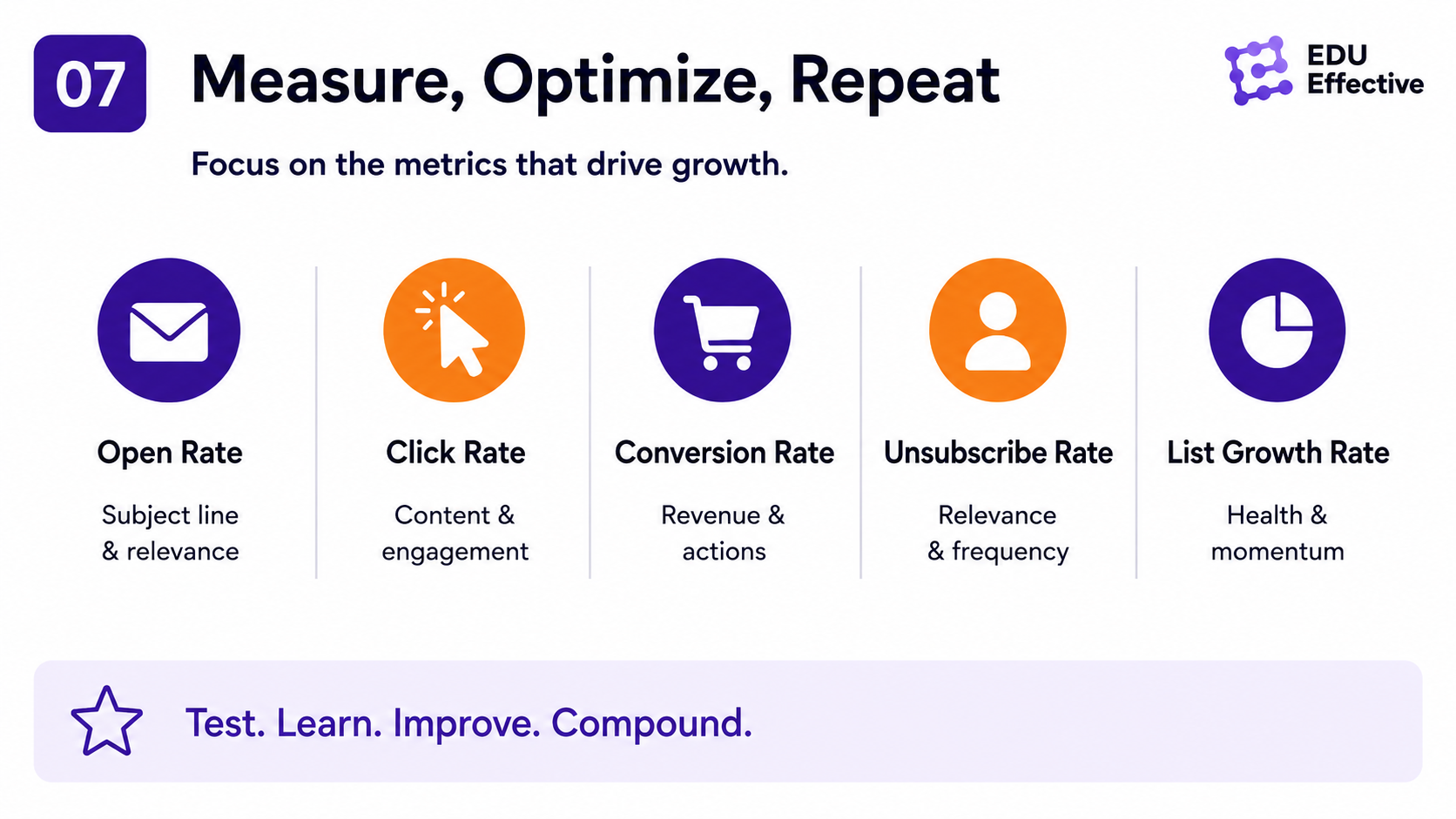
Open rate is the most widely tracked email metric and one of the least reliable indicators of programme health in 2026. Apple Mail Privacy Protection, introduced in 2021 and now widely adopted, records email opens automatically for a significant portion of Apple Mail users regardless of whether the email was actually viewed. This inflates open rate figures materially, making cross-programme comparison using open rates unreliable.
The metrics that more reliably indicate email programme health and commercial impact are click-through rate (the proportion of recipients who click at least one link — a signal of genuine engagement that is harder to artificially inflate), conversion rate (the proportion of email recipients who complete a desired action), revenue per email sent (the total revenue attributed to a campaign or sequence divided by the number of emails sent), and list growth rate (net new subscribers as a proportion of the existing list, which indicates whether the programme is growing or decaying).
For automated sequences, measuring revenue per sequence — the total revenue generated by each automated flow over a rolling 30-day or 90-day period — provides the clearest picture of where automation investment is producing the highest returns and where improvement would have the most commercial impact.
At EDU Effective, we build programs for professionals who want to work smarter — not just harder. Explore our programs →
EDU Effective Business School = professional development for your long-term success.
All best-selling Effective MBA programs are built for working adults: 15 minutes a day, 10 months or less, ASIC accredited, from €990.
- Effective MBA: Executive Management & Leadership
- Effective MBA: Applied Artificial Intelligence
- Effective MBA: Coaching, Leadership & Mentoring
- Effective MBA: Mastery in AI
- Effective MBA: Online Marketing
These are professional programs, not academic ones — built for working adults to apply what they learn directly in their own business, not to collect a scholarly credential.
Join more than 9,000 students in over 120 countries around the world to further your personal development and career success.
Read the feedback and experiences of our students and the stories of our graduates here.
Apply now — from €990 · Talk to a Study Advisor
Study with NO risk: 14-day money-back guarantee, no questions asked.
Sources
- Litmus — Email Marketing ROI Study 2026 https://www.litmus.com/blog/email-marketing-roi
- HubSpot — State of Marketing Report 2026 https://www.hubspot.com/state-of-marketing
- Salesforce — State of Marketing Report 10th Edition 2026 https://www.salesforce.com/resources/research-reports/state-of-marketing/
- McKinsey & Company — Unlocking the next frontier of personalized marketing https://www.mckinsey.com/capabilities/growth-marketing-and-sales/our-insights/unlocking-the-next-frontier-of-personalized-marketing
- Campaign Monitor — An Agency’s Guide to Email Marketing (2026 Edition) https://www.campaignmonitor.com/resources/guides/email-marketing-and-automation-for-agencies/
- Mailchimp — Email Marketing Benchmarks 2026 https://mailchimp.com/resources/email-marketing-benchmarks/
- Omnisend — Key ecommerce digital marketing statistics for 2026 https://www.omnisend.com/blog/digital-marketing-statistics/
- Statista — Email Users Worldwide 2026 https://www.statista.com/statistics/255080/number-of-e-mail-users-worldwide/